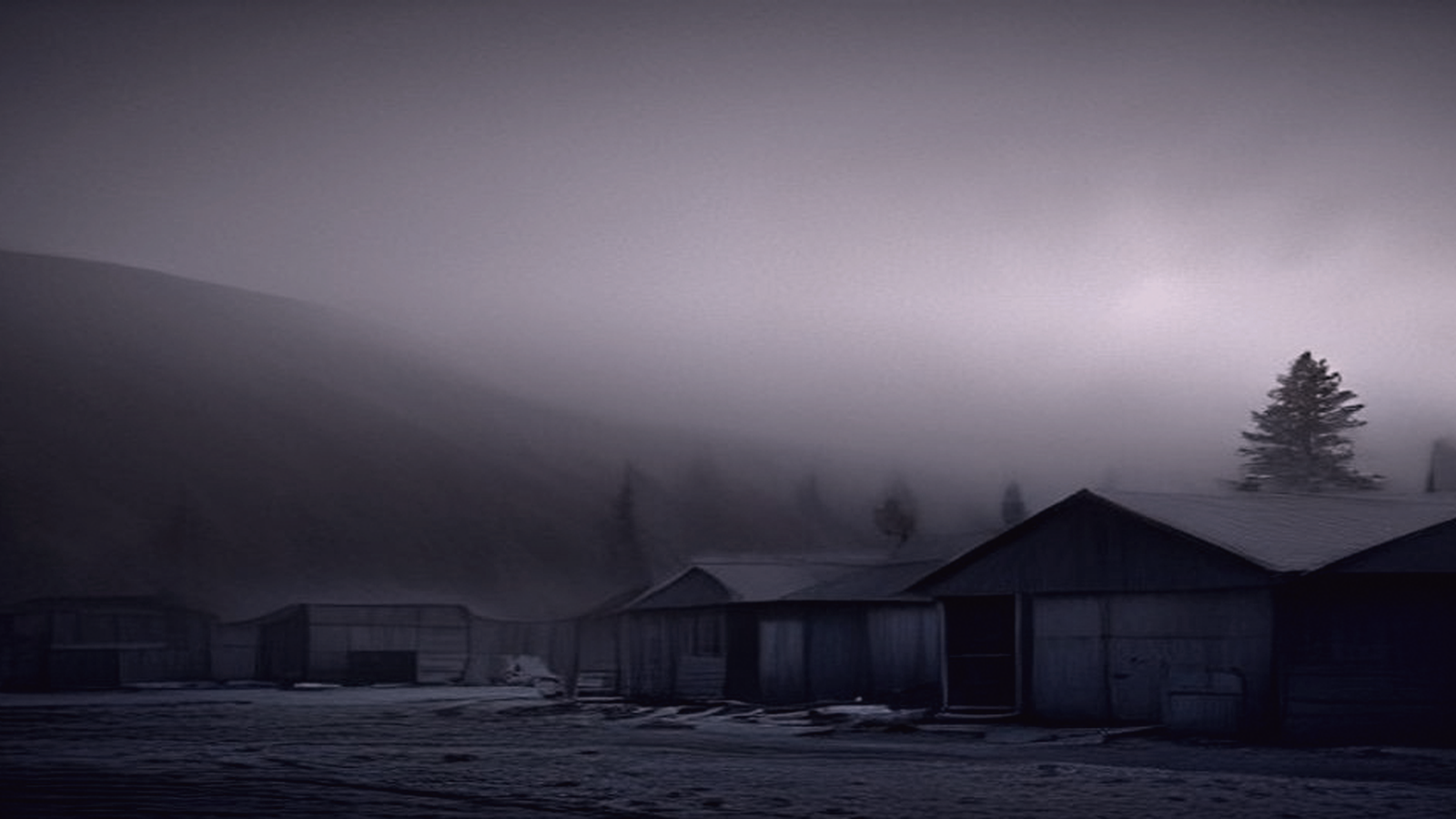
Booker Sowerby walked across the frozen gravel of the upper yard. His work boots made a hard, dry crunch against the ice.
The air smelled of wet spruce needles, woodsmoke, and the sour oil of dead machinery. It was nine in the morning, but the sun was trapped behind a ceiling of dark slate cloud that did not move. He was here for the monthly facility assessment with Mr. Jenkins, the camp caretaker. The mining camp had been closed since October, three months back, but the owners kept two men on the ledger to ensure the pipes did not freeze and the snow loads did not crush the roofs of the mess hall. It was routine work. Booker knew the routine by heart.
Outside the six-by-eight caretaker's cabin, Jenkins stood near the front porch. He wore a heavy brown duck-canvas coat dusted with frost at the collar. In his right hand he held a red steel thermos, steam curling from the mouth in narrow white ribbons.
"Morning," Booker said.
Jenkins grunted into his beard. He turned without a word and led the way inside, his heavy boots clattering on the two wooden steps.
The cabin was eight paces wide and twelve paces deep. A small cast-iron stove sat in the corner, radiating dry heat that smelled of scorched pine bark. A low faux-leather couch backed against the left wall, its vinyl split along the seams to expose yellow foam stuffing. Opposite the couch, a pine workbench stood cluttered with grease tubes, rusted socket wrenches, and half-empty cans of 3-in-One oil.
Booker sat on the couch. The vinyl groaned beneath his weight. He unbuttoned his top coat and ran his palm across his damp hair, waiting for Jenkins to settle.
Jenkins rummaged in a drawer beneath the workbench, his thick fingers turning over yellowed paper. He pulled out a stapled stack of maintenance logs and handed them over to Booker.
Booker picked up the stack. As he flipped through the top sheet, his eyes caught a folded jacket slung over the far arm of the couch. It was olive drill canvas with an uneven hem where the bottom thread had pulled loose. On the right elbow, a square patch of dark green felt had been sewn on with heavy black thread.
It was his own jacket. He had worn it three weeks ago during a midnight call, when the rain had soaked through the canvas and he had spent an hour shaking it dry over the floor vents of the ambulance.
A cold taste like copper filings sat on the back of his tongue.
Booker looked at the jacket, then up at Jenkins. The old man was standing by the stove, his spectacles resting far down the bridge of his nose.
"What's that?" Booker asked, nodding toward a small iron key on the table beside the paper stack.
Jenkins looked at the table. A shallow crease formed between his white eyebrows.
"Must be from the caretaker," Jenkins said. "Uses it for locking up the spare gear in the storage rooms."
Booker stared at the key. The blade was four inches long, handmade, with a curved bit and three sharp square notches cut into the iron.
"You're the caretaker," Booker said.
Jenkins did not answer. He turned back to the stove, adjusting the iron damper with a gloved hand. The stove gave a dull metallic thud.
Booker reached out to touch the jacket on the arm of the couch. His fingers met empty vinyl. The couch arm was bare. The yellow foam peeked through the split seam, bone-dry and covered in lint.
He drew his hand back. His heart hit his ribs once, hard.
It was just a coat. You're tired. That's all.
Jenkins began talking about the ventilation shaft in the deep north drift, his voice low and flat, like water running through an iron pipe. Booker sat with the maintenance logs in his lap, staring at the spot on the table where the iron key lay beside two unwashed white ceramic mugs.
Booker stood up. He set the paper stack back on the pine table without reading the second page.
"I'll go take a look around," he said.
Jenkins did not turn around. His hands stayed on the damper handle.
Booker walked past the workbench and down the narrow hallway toward the rear of the cabin. The temperature dropped five degrees with every three paces. The air smelled of wet limestone and damp wool.
At the end of the hall stood a solid oak door fitted with a heavy brass faceplate. Stamped into the tarnished metal were the block letters: CARETAKER'S QUARTERS. Beneath the plate was a keyhole, wide and dark, framed in rusted iron.
Booker pulled the curved iron key from his pocket. He did not remember picking it up off the table.
He pressed the bit into the keyhole. The key slid in smooth, coated in thin grey grease. He turned it clockwise.
A heavy, dry click sounded inside the door frame.
Booker pushed the door open.
The room inside was six feet wide by eight feet deep. It contained a narrow iron cot with a grey wool blanket, a small pine washstand, and a black rotary telephone sitting on a bare nightstand.
The telephone began to ring.
The brass gongs inside the Bakelite shell struck with a sharp, violent clatter that rattled the glass in the single windowpane.
Booker froze on the threshold. The sound hit his ears like a nail driven into soft pine.
From the front room, Jenkins' voice called out: "Booker?"
Booker did not answer. He kept his eyes on the black telephone. The receiver rested in its cradle, untouched, but the double bell clanged four times, five times, six times, continuous and dry.
He reached down and lifted the heavy Bakelite receiver to his ear.
There was no dial tone. There was no static.
The ringing continued inside the ear cup, loud and metallic, vibrating against his jawbone while the hook switches remained pressed flat beneath his thumb.
Booker stepped backward into the hallway, pulling the oak door shut behind him. The lock clicked engaged.
He walked back into the main room. The cabin was quiet except for the low rumble of the stove. Jenkins was not at the workbench. He was not by the stove.
Booker picked up the two white ceramic mugs from the pine table and carried them to the zinc sink in the corner. He set them down beside the brass faucet.
As he turned back toward the room, a thought formed in his mind, sharp and clear, articulated in Jenkins' raspy voice before any sound was made:
Yeah, I'll make sure to check the logs.
Booker stopped. He pressed his knuckles against the edge of the zinc counter.
Two seconds later, the front door clicked open. Jenkins walked in, carrying an armload of split birch logs. He dumped them into the iron box beside the stove and wiped his dirty gloves on his trousers.
"Yeah," Jenkins said, his voice matching the cadence in Booker's head exactly. "I'll make sure to check the logs."
Booker felt the hair on his arms stand up. His tongue felt dry, thick with the taste of iron.
You heard him coming up the steps. Your brain filled in the rest.
Jenkins walked past him toward the workbench, his boots dragging on the floorboards.
Before Jenkins spoke again, the next sentence landed in Booker's mind, complete with a slight breath pause between the third and fourth words:
Not much going on, just keeping an eye on things.
Jenkins reached for a wrench on the bench, turned his head halfway, and spoke:
"Not much going on. Just keeping an eye on things."
Booker backed toward the door. His spine touched the wood frame beside the jamb.
On the wall paint, three inches from his left shoulder, a series of vertical tally marks was scratched into the dark green enamel. They were carved deep into the wood beneath the paint, filled with dry grey dust.
Five strokes crossed through. Another five. Another five.
Then single lines: 17, 19, 21.
The number 21 had been freshly gouged. A faint curl of dry green paint hung from the tail of the second digit, ready to fall.
Booker turned away from the wall and moved to the small comms shelf mounted beside the front window.
A grey satellite handset rested in a wall bracket above a high-frequency radio console. Booker pulled the handset down and flipped the power toggle. The small LCD panel flickered once, showing a dark, blank screen. No battery icon. No signal bars.
He extended the telescopic antenna until it hit the metal stop. He pressed the push-to-talk bar on the side of the casing.
"Jenkins?" he said into the black plastic grate. "Anyone?"
Static hummed from the small oval speaker on the wall console, a flat, unbroken hiss like dry sand falling on tin.
He walked to the window and looked out across the lower yard.
The main gate was fifty yards off: two heavy wrought-iron panels chained together with a link chain the thickness of a wrist and secured with a rusted brass padlock. Beyond the gate, the narrow dirt access road stretched out through the black pine forest, disappearing into the grey fog settling over the ridge.
A square battery clock hung on the wall above the window. Its second hand was dead, stuck between four and five. The black hands pointed to 4:17 p.m.
Booker looked at his own wrist. His watch showed 4:17 p.m.
Out by the iron gate, parked sideways across the frozen gravel, sat Jenkins' yellow Ford pickup.
Booker narrowed his eyes against the grey glare off the ice.
The truck had been bright, clean yellow when Booker walked past it forty minutes ago. Now the paint along the driver's side was dull, oxidized to a chalky mustard color. Along the door panel, four thick grey scuffs ran from the front fender to the door handle, deep gouges through the paint where the bare metal beneath had already turned red with rust.
A cold taste like copper filings sat on the back of his tongue.
The truck had not moved. No one had been near the gate.
The sun is dropping. The light is changing the color.
He pushed the door open and stepped out onto the porch.
The wind had picked up. It came off the upper ridge in short, hard bursts that carried the smell of ozone and wet coal.
Booker walked down the two steps, holding the handheld radio against his ribs.
The radio speaker sputtered. A voice came through the static, thin, chopped by interference, but unmistakable:
"...and I'm saying, try the north face again..."
It was Jenkins' voice. But Jenkins was inside the cabin, fifteen feet behind him.
Before the radio finished the phrase, Booker heard the rest of it in his own mind, every syllable dry and flat:
...before the freeze sets into the line.
The radio speaker vibrated: "...before the freeze sets into the line."
Booker stopped in the middle of the frozen yard. He lifted his head. The sky was dark slate, the clouds sagging low over the tops of the pine trees.
To his left, the small side window of the mess hall reflected the grey yard. Booker walked past it, his eyes tracking his image in the grimy double glass.
His reflection was thin. His cheeks looked hollowed out, the skin stretched tight over the bones. Dark circles framed both eye sockets, as if he had not slept in three weeks.
As he watched, his reflection stopped walking.
Booker took another step forward, but the figure in the windowpane stayed motionless, standing on the icy gravel, staring back at him through the dust on the glass.
Behind the figure's left shoulder, inside the dark interior of the locked mess hall, something shifted. It was not a shadow. It was a shape the size of a man, motionless, pressed close against the inner pane.
Booker spun around.
The yard was empty. Only his own boot prints marred the ice, leading from the cabin porch to the middle of the gravel track.
It was an optical flare. The double glass.
He walked fast toward the generator shed at the eastern corner of the main building.
The shed was built of heavy concrete block with a corrugated iron door. A brass latch held it shut.
Booker reached out. His fingers hovered two inches above the cold brass handle.
Inside the shed, the diesel generator was already running.
He lifted the latch and pushed the heavy iron door inward.
The generator sat on a poured concrete pad in the center of the room: a heavy, four-cylinder industrial unit caked in black grease and diesel sludge. It hummed with a low, rhythmic thud that vibrated up through the soles of Booker's boots and into his knees.
The air smelled of hot engine oil, zinc, and unburnt fuel.
On the wall above the fuel tank, a red digital display was wired into the main breaker panel. The LED numbers glowed through the gloom:
05:21 P.M.
Booker raised his left arm. He looked at his stainless steel wristwatch.
The small black hands pointed to 04:17 P.M.
He waited. He watched the second hand on his watch. It did not move. It stayed frozen over the twelve mark, vibrating with the pulse of his own wrist.
"You know you have to get going soon, Booker," a voice said.
The voice came from two inches behind his left ear. It was dry, flat, and warm.
Booker turned around so fast his heel skidded on the oily concrete.
There was no one behind him. The shed was eight feet square. The concrete wall behind him was bare, stained with black mineral runs from a leak in the roof.
He backed up until his shoulder blades struck the breaker box.
Behind the generator unit, in the narrow two-foot gap between the radiator grill and the back wall, the air was wrong.
It was ten degrees colder than the rest of the room. The air there looked thick, shimmering slightly like heat rising off asphalt, smelling of wet river silt and copper filings.
Booker's breath came fast now, short and shallow.
This is an anxiety response. Hyperventilation.
He looked back at the digital panel on the wall.
The red numbers 05:21 P.M. were no longer solid. The digits were melting, red light running down the grey plastic housing in thick, bright drops like wet varnish.
The low hum of the diesel engine began to pitch upward.
The rhythmic thud shifted to a high, metallic screech—a gear spinning out of alignment, teeth grinding against teeth with a pitch that set his back molars aching.
The single overhead bulb flared once, bright white, and snapped.
Darkness dropped like a stone.
The dark was immediate and absolute.
The screeching from the generator died, replaced instantly by a heavy quiet that pressed against Booker's eardrums like deep water.
The air smelled of raw copper, wet clay, and fresh formaldehyde.
Booker reached out both hands, searching for the concrete wall or the metal casing of the breaker panel. His fingers found nothing. The space around him was wide and cold.
He took one step forward. His boot did not hit concrete.
The floor beneath him felt smooth, cold, and slightly soft, like heavy vulcanized rubber coated in thin oil.
He lost his balance and fell to his knees.
His right hand struck a hard object on the floor. He drew his fingers across it: a flat rectangular plate of iron, four inches wide, with jagged, sharp edges where it had been sheared from a frame.
The air around his head began to vibrate.
A low, heavy pulse beat through the floor at fifty-eight beats per minute. It was the rhythm of a rested heart.
Something pulled at his chest. Not a hand, but a heavy gravitational shift, as if the room had been tilted ninety degrees onto its end. His body felt weightless, his feet slipping off the rubber floor as he slid into the dark.
A voice spoke directly into his jawbone, vibrating through his teeth:
"Booker."
The overhead light flickered on.
The light was cold white fluorescent, humming at 120 hertz directly above his face.
Booker was not in the generator shed.
He was lying on his back on a steel-framed cot in a white vinyl room six paces square. The air smelled of isopropyl alcohol, floor wax, and cold coffee.
Across the room sat a woman behind a dark laminate veneer desk.
She wore a dark grey tailored suit. A brass nameplate on the desk read: DR. E. RODRIGUEZ — CLINICAL EVALUATION.
Her face was pale and perfectly smooth, but her eyes were wrong: the irises were solid dark obsidian, with no distinction between pupil and ring. The skin around her jawline had two thin, dry seams running down toward her collarbone, like leather that had been stretched over a wooden frame and stitched tight.
She looked at Booker and smiled.
Her mouth opened too wide, revealing two rows of small, pointed teeth, perfectly spaced, like the teeth of a pike.
"You're safe now," Dr. Rodriguez said. Her voice was flat, soothing, and completely devoid of pitch. "The system has been reinitialized."
Booker sat up slowly. His hands were shaking. His fingernails were grey.
On the wall behind her desk, a small silver digital clock glowed in blue light:
06:04 A.M.
Booker lay back down on the thin cot. He turned his head and stared at the acoustic ceiling tiles six feet above him.
There were 648 small grey pits on the tile directly over his chest. He counted them. He had counted them before.
Memory slipped away from him like cold water through greased fingers—the ice in the yard, the yellow truck, the iron key, the smell of burnt pine—all smudging into a single, flat, administrative distance.
Dr. Rodriguez picked up a black ballpoint pen from her desk.
She unclipped a manila file folder marked SOWERBY, BOOKER — EVALUATION CYCLE 21.
The pen made a dry, rhythmic scratch against the paper:
Booker Sowerby: Administrative Leave status revised. Reinstatement pending further review.
The heavy oak door at the side of the room opened.
A man in a brown canvas work coat entered carrying a red plastic tray. On the tray sat two white ceramic mugs and a small paper plate with three dry biscuits.
"Morning, Doctor," Mr. Jenkins said.
He set the tray on the edge of the laminate desk. He did not look at Booker lying on the cot. He turned and walked out, closing the door behind him with a flat, dull click.
Outside the narrow transom window at the top of the wall, rain began to patter against the glass in a slow, steady rhythm.
On the corner of the desk, a small battery radio played a low morning news broadcast, the announcer's voice bright and oblivious.
Underneath the floorboards, deep within the building's wiring, a single tone hung in the air—5:21 p.m., still waiting for someone to answer.