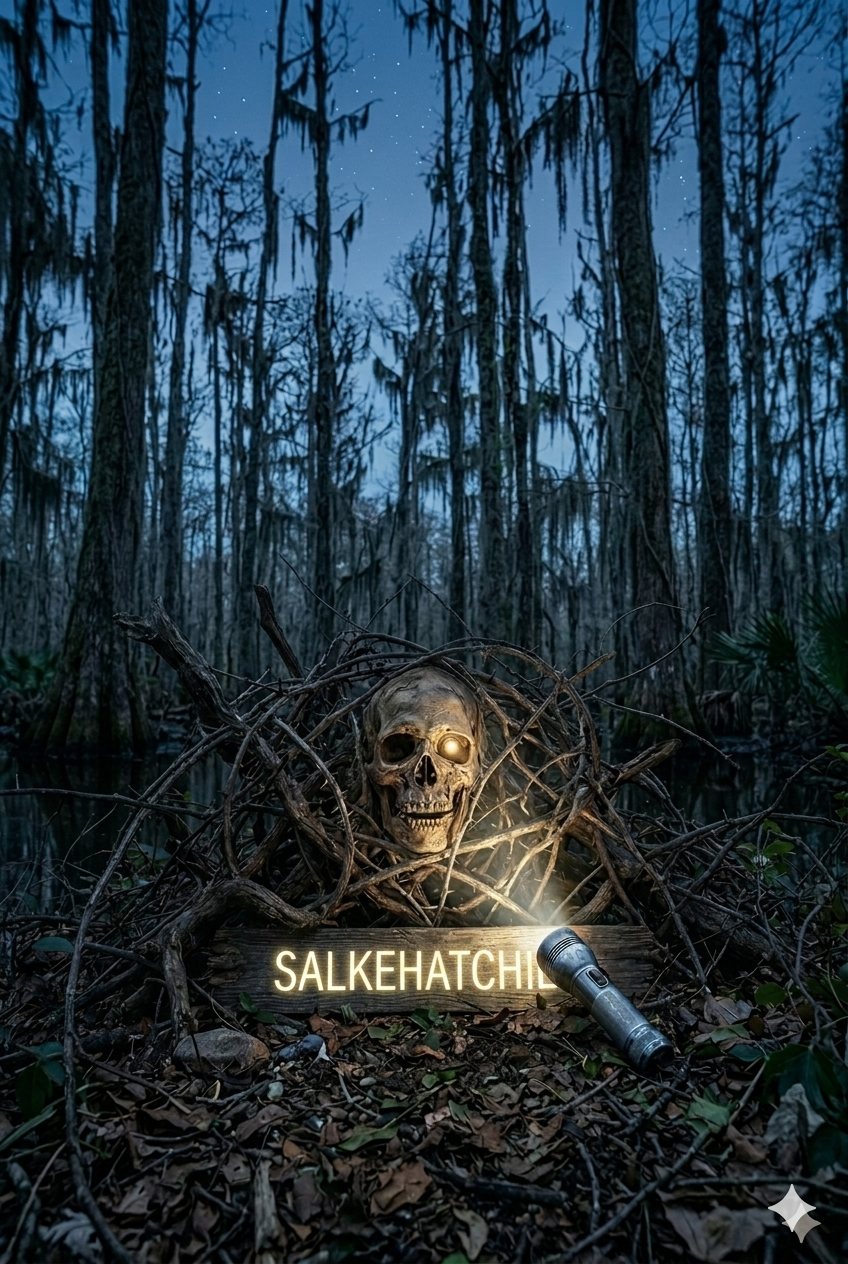
The parking lot at Rivers' Bridge Battlefield was a void of gravel and silence, a flat grey expanse hemmed in by the oppressive green walls of the South Carolina swampland. The sunset didn't offer a glow; it was a jagged tear across the western horizon, the color of a fresh bruise. Elijah killed the engine of his SUV, but he didn't get out. He sat in the sudden, ringing quiet, watching the dust motes dance in the dying light.
He had come for the "solitude" his therapist insisted was necessary. After months of overwhelming anxiety, he was told that he needed to get out more and nature would provide "tranquility." This hike had become a regular part of his routine to begin the weekend. Three spaces away sat a car that shouldn't have been there. It was an old, rusted sedan, its bodywork caked in layers of grey silt as if it had been driven through a desert and left to rot. Next to it stood a man.
The man was silhouetted against the violet sky, his posture unnaturally rigid. He was dressed in an old Civil War outfit. Wow, he takes these reenactments pretty seriously, Elijah mused to himself, looking at a suit of clothes that seemed far too heavy for the humid evening—thick, dark wool that seemed to absorb the light. He stood perfectly still, his head tilted at an angle that suggested he wasn't looking at the scenery, but listening to something deep within the earth.
When Elijah finally stepped out, the man turned.
The movement was too fluid, too synchronized. His face was a masterpiece of mimicry; the skin looked like cured leather stretched over a skull that didn't quite fit the mold. His eyes were lightless craters, and his smile was a jagged error—far too wide, revealing teeth that were too numerous and far too sharp.
"Evening," the man said. The voice wasn't a sound; it was a vibration, like a recorded message played through a throat of dry leaves and static. "Beautiful night for a hike."
"Yeah," Elijah muttered, his heart hammering a frantic rhythm against his ribs. "Just hiking the loop."
"Be careful," the man's smile stretched, a tiny tear of dark, oily fluid beginning to form at the corner of his eye.
Elijah didn't answer. He gripped his flashlight tighter and hurried toward the trailhead. He forced himself not to look back, but the sensation of those hollow eyes was like a physical weight pressing against the back of his neck.
Halfway to the trees he passed the gravel spur that ran down to the old boat landing. A white cargo van idled at the water's edge, clean and unmarked, its rear doors open to the black river. Two men in waders stood hip-deep in the current—not fishing. They were ladling something heavy and dark out of the riverbed into steel drums, with the unhurried patience of men filling an order they had filled a thousand times before. Neither of them looked up. Elijah looked away first, and walked faster.
At the entrance to the woods stood the official National Park Service signage. It was a weathered brown board, but as Elijah approached, the text seemed to shimmer and rearrange itself in the fading light.
"This is a terrible place to fight a battle," one soldier wrote in February 1865. The Salkehatchie swamp was a dense, secondary growth of cypress, scrub oak, and brier thickets so thick that visibility was reduced to a few yards. In these woods, regiments lost their way. The wounded were often consumed by the black water or fires ignited by the muzzle flashes. The geography of the fight was lost to the smoke. Over 134 soldiers went missing that day.
He clicked on his flashlight. The beam was a pathetic, pale yellow line that barely managed to cut through the gathering gloom. He stepped onto the path, and within ten yards, the parking lot was gone. It didn't just fade; it was as if a curtain had been drawn shut. The thickets of scrub oak and brambles seemed to knit themselves together behind him, sealing the exit with a wall of interlocking thorns.
The silence was the first thing to change. It was no longer the quiet of nature; it was the silence of an empty room. No crickets sang. No frogs called from the marsh. There was only the rhythmic crunch-crunch of his boots on the gravel, and the sound of his own breathing, which felt far too loud in the stagnant air.
A mile into the hike, Elijah stopped to check his phone's GPS. The screen flickered violently, a line of white static cutting through the digital map. The blue dot that represented his location was spinning in a slow, clockwise circle.
I should have reached the old breastworks junction by now, he thought.
He looked at the trail ahead. It was narrowing. The vegetation was leaning in, the jagged edges of the Spanish moss catching on his sleeves like tiny, desperate fingers. The air grew thick, smelling faintly of old iron and scorched wool. Panic, familiar and cold, began to coil in his gut. This wasn't the therapeutic tranquility he had been promised. This was a trap.
He turned to go back, but the gravel path he had just walked was missing. In its place was a narrow, muddy rut hemmed in by ancient, gnarled roots that looked as if they had been growing there for centuries.
Elijah raised his flashlight, his hand trembling. The weak beam swept across the newly formed mud, tracing up the trunks of the choking oaks.
Then, the light caught something.
Fifty yards away, standing in the center of the narrow rut, was a silhouette. It was the man from the parking lot. Even in the pitch black, Elijah could see that the man's head was still tilted at that unnatural, broken angle, listening to the dirt.
Elijah's thumb convulsed on the flashlight switch. The beam flickered violently, dying out for one agonizing second. The darkness that rushed in was absolute. When the light buzzed back to life, the rut was empty.
The man was gone.
A sharp, ragged gasp tore from Elijah's throat. Reason abandoned him. He turned and ran.
He didn't look for a path anymore; he just ran away from the space where the man had been. But the woods had ceased to make sense. Every time he veered left, the trees seemed to shift, forcing him into a sharp right. The trail fragmented into a dizzying maze of identical, suffocating corridors of briar and thorn.
Branches whipped across his face, slicing his cheeks. The ground beneath his feet mutated with every step—shifting from wet mud, to dry sand, to a crunching floor of brittle, white branches that sounded horribly like snapping ribs.
"Help!" he screamed, his voice swallowed instantly by the dead air. "Is anyone out there?!"
The forest answered with a sound that made his knees buckle. It was a low, collective sigh, rising from the earth beneath him. A chorus of thousands of whispered groans, muffled by dirt and time.
His legs were failing him, his lungs burning with the hot, stagnant air. His flashlight beam bounced erratically across the shifting foliage until it caught a massive, jagged tear in the side of a limestone bluff ahead. It was a cave—an impossibly deep, jagged opening yawning out from the roots of a massive, dead oak.
It wasn't a natural formation for this lowcountry swamp, but Elijah didn't care. It was a barrier. It was a place to hide.
He lunged through the opening, tumbling into the freezing, subterranean dark just as his flashlight gave one final, dying sputter, and went completely black.
The darkness inside the cave was not merely the absence of light; it was a heavy, suffocating weight that pressed against Elijah's eyes. He sat on the damp, cold floor, his breath coming in ragged, hyperventilating gasps. He shook his flashlight violently, smacking it against the palm of his hand. It emitted a pathetic, dying click—a half-second spark of yellow that revealed walls of glistening, black stone—before dying completely.
The air was freezing, a stark contrast to the oppressive South Carolina humidity outside. It smelled intensely of copper, wet clay, and something deeply foul—like meat left to rot in a closed trunk.
Calm down, Elijah told himself, his therapist's breathing exercises echoing uselessly in his mind. Inhale for four seconds, hold, exhale. You're just having a panic attack. The woods didn't change. You just got lost.
But then he heard it.
A soft, rhythmic sound echoed from the deep recesses of the cavern. It wasn't the sound of dripping water. It was the sound of fabric rubbing against fabric, accompanied by the wet, dragging scrape of a boot.
Shuffle. Scrape. Shuffle. Scrape.
Someone—or something—was down here in the dark with him.
Elijah scrambled backward on his hands and knees, his fingernails tearing as they scraped against the jagged rock floor. He backed up until his spine hit the frozen stone wall of the cave. He held his breath, burying his face in his knees, praying that the darkness would hide him.
The dragging footsteps grew closer, passing right by the entrance where he had collapsed. In the absolute blackness, Elijah felt a sudden, icy draft cut through the air, carrying the overpowering stench of stagnant swamp water and old, unwashed wool. A wet, rattling wheeze vibrated just feet from his face, followed by a voice that sounded like grinding stones:
"Where did the boys go? The river is rising..."
Elijah pressed his hands over his mouth to choke back a scream. He squeezed his eyes shut so hard he saw stars. He waited for the hands to grab him, for the needle-sharp teeth of the man from the parking lot to tear into his throat.
But the footsteps didn't stop. They continued past him, deeper into the cavern, slowly fading into the distance until they were swallowed by the silence.
Elijah waited for what felt like hours, his limbs freezing and cramping in the subterranean chill. He couldn't go back out. The thought of the shifting, living labyrinth of the Salkehatchie swamp terrified him more than the dark.
Then, he blinked. Farther down the tunnel, where the dragging entity had gone, a faint, impossible glow began to bleed through the blackness.
It wasn't the harsh, white glare of modern LED light. It was a soft, flickering, amber hue—the unmistakable glow of firelight. Along with the light came a distant, muffled cacophony of sound. It sounded like a thunderstorm, but rhythmic. Thump. Thump. Thump. Interspersed with the thunder were sharp, cracking snaps and faint, distant screams that sounded like a flock of birds being torn apart.
Driven by a desperate, primal need to see where he was going, and foolishly hoping it might be a park ranger or a group of campers, Elijah dragged himself to his feet. He used the cavern wall as a guide, keeping his left hand pressed against the slick, wet rock as he stumbled toward the amber light.
With every step he took, the temperature began to rise. The freezing subterranean chill evaporated, replaced by a sudden, sickening wave of heat that caused sweat to break out across his forehead. The smell of copper grew violently intense, accompanied now by the suffocating stench of burning wood and sulfur.
He was getting closer. The tunnel began to widen, the amber light casting long, dancing shadows across the ceiling. Elijah slowed his pace, creeping forward with absolute caution, his heart hammering against his ribs like a trapped bird.
Drip.
Something wet and warm struck the exact center of his forehead.
Elijah paused, wiping his brow with the back of his hand. He brought his hand down to his eyes, trying to catch it in the faint, flickering light from the end of the tunnel.
It wasn't water. It was thick, dark, and viscous. Even in the dim amber glow, he could tell it was a deep, brilliant crimson.
Drip. Drip.
Two more heavy drops fell, one landing on his shoulder, the other splashing directly onto his cheek. Elijah slowly, dreadfully, tilted his head upward.
The ceiling above him was alive. The black limestone was porous, and from the thousands of tiny fissures in the rock, a thick, dark curtain of blood was weeping from the earth. It wasn't a slow leak; it was a rhythmic, pulsing flow, as if the very mountain above him had a heartbeat, pumping gallons of fresh, hot blood down through the stone.
A choked gasp escaped Elijah's throat. He took a violent step backward to escape the downpour of blood, his boot slipping on the slick floor.
He lost his balance and fell hard, tumbling backward down a steep, unseen incline. He expected to hit the hard stone floor, but instead, his fall was broken by a horrific, hollow crunching sound.
He didn't hit rock. He hit a pile of something loose, brittle, and impossibly dense.
Elijah scrambled to sit up, his hands plunging deep into the pile to support himself. His fingers closed around something smooth, round, and hollow. He frantically pulled his hand back, shaking it in terror, as the amber firelight from the exit finally illuminated the pit he had fallen into.
He was sitting in a mountain of bones.
There were hundreds of them—perhaps thousands. Skeletons, stripped entirely of flesh, piled high like cordwood in a massive depression in the cave floor. They weren't ancient; the bone was stark, brilliant white, but many of them were shattered, crushed, and blasted apart. Elijah looked down between his thighs and found himself staring into the hollow, eyeless sockets of a human skull. Its jaw was frozen open in a permanent, silent scream, and a rusted, iron minie ball bullet was still embedded deep in its forehead.
Everywhere he looked, there were ribcages, femurs, and fractured skulls, all tangled together in a sickening display of mass slaughter. The blood dripping from the ceiling was raining down upon them, coating the white bones in a gleaming, gory sheen.
The sheer, unadulterated horror of the sight broke whatever thin thread of sanity Elijah had left.
He screamed—a loud, piercing shriek that echoed off the cavern walls. He scrambled frantically on his hands and knees, kicking and thrashing as the brittle bones snapped and crunched beneath his weight. He dragged himself up the opposite side of the pit, his clothes completely soaked in the blood of the ceiling and the dust of the dead.
He didn't care about being quiet anymore. He didn't care about what was waiting for him. He just needed to get out.
He lunged toward the roaring amber light at the end of the tunnel, bursting through the exit of the cave and collapsing into the blinding brightness of the outside world.
The light that greeted Elijah didn't come from a peaceful South Carolina morning. It was a harsh, blinding glare, choked by a dense, yellow-grey fog that tasted of sulfur, ash, and copper. He lay gasping on a bed of crushed pine needles and thick, black mud, his eyes stinging as they adjusted.
The quiet of the modern state park was completely gone. The air vibrated with a deafening, catastrophic roar. Thump-thump-thump—the relentless pounding of Union artillery. Through the thick smoke came the sharp, rhythmic crack-crack-crack of thousands of rifled muskets, accompanied by the panicked, screaming bray of dying horses and the guttural, collective roars of charging men.
Elijah dragged himself up against the trunk of a massive, scarred cypress tree, his breath hitching. He looked down at himself and let out a choked cry.
His modern hiking clothes were gone. In their place was a heavy, coarse wool uniform. It was a deep, muddy grey, the fabric stiff with grease, sweat, and dried blood. A heavy leather cartridge box slapped against his hip, and a rusted brass belt buckle bearing the seal of South Carolina dug into his stomach. His hands were stained black with powder residue.
No, no, no, he thought, his mind fracturing. This is a reenactment. It has to be. A historical simulation. Some kind of extreme psychological event.
Just then, a man burst through the yellow smoke twenty feet away. He wore a blue wool coat, his face completely blackened by gunpowder soot, his eyes wide with a manic, feral terror. He was sprinting blindly toward Elijah's tree, bayonet fixed to his rifle.
"Get up, you rebel son of a bitch!" the man screamed, his voice cracked and raw.
Before Elijah could even raise his hands to plead, a blinding flash erupted from the thicket behind him. The sound was a physical blow that shattered Elijah's eardrums. A solid iron cannonball tore through the fog, striking the running Union soldier directly in the chest.
The man didn't just fall; he disintegrated. A horrific spray of dark crimson, bone fragments, and shreds of blue wool rained down across the mud, splashing over Elijah's face and uniform. The smell of opened, burning flesh rushed into Elijah's nostrils—hot, foul, and undeniably real.
This wasn't a simulation. There were no safety protocols here. He had been dropped directly into the meat grinder of February 1865.
Panic, absolute and primal, took over. Elijah turned and fled into the thickest part of the swamp, away from the screaming and the thunder of the guns. He splashed blindly through knee-deep black water, tripping over submerged roots and tearing his wool uniform on the jagged, submerged branches of the Salkehatchie.
The smoke followed him, weaving through the cypress knees like living fingers. The gunfire began to recede into a dull, echoing roar, muffled by the dense, suffocating canopy of the swamp.
Exhausted, his lungs burning from the sulfurous air, Elijah collapsed against the wide, flared base of an ancient, hollow cypress tree. He slid down into the freezing mud, burying his face in his hands, weeping uncontrollably. He was trapped in a nightmare with no waking up, a historical ghost story that had swallowed him whole.
A strange, rhythmic rustling sound began to grow around him.
It didn't sound like the battle. It was a dry, scraping, clicking noise, rising from the bark of the tree behind his head and the mud between his knees.
Elijah pulled his hands away from his face. His heart stopped.
The trunk of the cypress tree was moving. Thousands of massive, black wolf spiders were pouring out from the hollow knots of the wood, their hairy legs bristling as they carpeted the bark. From the black swamp water around his boots, hundreds of water moccasins and copperheads were sliding to the surface, their jaws unhinging in a silent, collective hiss. From the moss above, a dense, dark cloud of biting flies and stag beetles dropped down, swarming over his wool sleeves.
He tried to scream, to stand up and run, but the insects and arachnids were already on him. They swarmed up his boots, locking his legs in place. They covered his hands, their tiny, jagged legs prickling against his skin. Yet, strangely, they didn't bite. They didn't sting. They simply flowed over him like a living, writhing wave, anchoring him to the earth.
The creatures began to detach themselves from his body, pouring off him and pooling into a massive, tangled mountain of scales, shells, and fur in the mud directly in front of him.
The animals began to compress, snapping and locking together like pieces of a horrific puzzle. The spiders formed the dark, coarse fabric of a heavy wool suit. The snakes twisted and braided themselves into a tall, rigid spine and neck. The swarming beetles hardened into the texture of cured, leathery skin.
Within seconds, the swarm took a terrifyingly familiar shape.
Standing in the black swamp water was the man from the parking lot. His head was still tilted at that broken, unnatural angle. His jagged, far-too-wide smile stretched across his leathery face, revealing the rows of numerous, needle-sharp teeth.
"You run well, Elijah," the man said. The voice vibrated through the humid swamp air, a sickening blend of dry leaves, static, and the faint, overlapping screams of the dying men from the battlefield nearby.
"What... what are you?" Elijah whispered, his voice trembling so violently he could barely articulate the words. "Why am I here?"
The entity tilted its head to the other side, a soft crack echoing from its neck. The tiny tear of dark, oily fluid at the corner of its lightless eye began to track down its cheek.
"I am the architect of the wilderness," the voice rattled. "I am the grey silt that fills the lungs of the forgotten. I have taken many forms, and I have walked your world under many names throughout the long, bleeding stretch of time."
The man took a slow, fluid step closer, the water not even rippling around his boots.
"The ancient ones called me Azrael," the entity whispered, its smile widening until the corners of its mouth began to tear, oozing the same dark, oily fluid. "The men in the dust of Canaan called me Molech. The weeping mothers of the desert knew me as Abaddon. To the broken spirits in these woods, I am simply the end."
Elijah pressed himself as hard as he could against the cypress tree, his fingernails digging into the rotting bark. "Please... just let me go back. Let me go home."
"There is no going back," the entity said, its voice dropping to a low, booming resonance that shook the mud beneath them. "This place belongs to me. Every drop of blood spilled in this swamp, every bone left to rot in the dark, is a stone in my house. You walked into my desert, Elijah. And no one has ever seen my true form and lived to tell the tale."
The leather skin of the man's face began to split open down the center, tearing from the forehead to the chin.
There was no skull beneath.
Instead, a yawning, infinite abyss of absolute darkness poured out from the rupture. The human illusion dissolved completely. The entity expanded, towering over the cypress trees, blotting out the yellow sky of 1865. It was a shifting, geometric nightmare of jagged, ancient iron, colossal weeping eyes that stared from the dark, and rows of crushing, monumental teeth that extended into infinity. It smelled of a billion rotting graves, of burning worlds, of the cold, dead spaces between the stars.
The sheer, cosmic terror of the sight struck Elijah like a physical blow. His mind couldn't process the geometry of what it was seeing; his vision began to blur, blood bursting from his nose and ears as his brain literally rejected the reality before him.
The entity reached down. It didn't use hands. It used a crushing weight of absolute, suffocating shadow that collapsed around Elijah's chest.
He didn't even have the breath left to scream. The bones of his ribs snapped inward, plunging into his lungs as the darkness squeezed. As his vision faded to black, the roaring of the battle of 1865 began to die away, replaced once more by that low, collective, eternal sigh of the thousands of missing soldiers buried beneath the South Carolina mud.
The parking lot at Rivers' Bridge Battlefield sat under the quiet, violet sky of a modern Friday evening.
The SUV sat empty in the gravel, its engine cold. Three spaces away, the old, rusted sedan remained, its bodywork caked in a fresh, thick layer of grey silt. Down at the boat landing, the white van was gone. The drums had left deep, parallel ruts in the mud, running down into the black water like the grooves of an old scar.
A gentle breeze blew through the Spanish moss, carrying the faint, rhythmic crunch-crunch of gravel from the trailhead. But there was no one there. The forest stood perfectly still, an oppressive, green wall, waiting for the next weekend hiker to step onto the loop.