Then, the phone rang.
John didn't want to answer it, but the mechanical ringing was deafening, vibrating the very frame of his cot. He dragged himself over, lifting the receiver with a trembling, slippery hand. "Stop calling me."
The voice that came through the earpiece wasn't Sarah's digitized stutter.
It was a different woman's voice. It was soft, trembling, and entirely breathless.
"John? John, please tell me you can hear me. It's me. It's Anna."
The name Anna sliced through the narcotic fog in his brain like a razor. John froze, the black receiver glued to his ear. The slender shadow by the sink seemed to shift, its broken head tilting just an inch lower.
"This is a joke," John stammered, his teeth chattering against the plastic. He forced a frantic, breathless laugh. "You're a program. A deepfake. They're using a new algorithm on me. You're not real. Anna is dead. The other voice told me so."
"John, no, listen to me!" the voice begged, sobbing heavily.
Through the earpiece, the background noise exploded. It wasn't the sterile silence of a digital generation. John could hear heavy, panicked breathing. The frantic rustling of clothes. The violent, hollow thud of a wooden door being repeatedly kicked.
"I'm alive, John! I'm right here in the house! Please, open the door! Look at my face! Drop the—"
A sudden, catastrophic crash echoed through the phone line. The voice turned into a piercing, blood-curdling shriek of pure, unadulterated terror.
"John, stop! It's me! I'm real! I'm re—"
A wet, sickening snap cut her off.
The line didn't go dead. Instead, it filled with a horrific, rhythmic rattling sound—the sound of someone desperately trying to gasp for air through a crushed throat.
John stood paralyzed. The sound was too visceral, too flawed, too perfectly human to be code. The rattling slowly tapered off, fading into a heavy, absolute silence.
And then, the floodgates broke.
The drug of the sludge failed entirely. The protective wall of his delusion crumbled, and the memory rushed in, blinding and dripping in blood.
He remembered the kitchen. He remembered the blinding, psychotic rage that had convinced him his wife had been replaced by an android, a fake sent to replace him. He remembered wrapping his hands around Anna's throat, feeling the warm, undeniable heat of her very real skin, pressing down with all his fury until the bone gave way.
The whispering frequency in the lights hadn't been an AI glitch. It was his own mind, screaming at him from the depths of his soul: She's not real, John. Admit it. Admit what you did.
Gasps of horror tore from his chest. He dropped the receiver, spinning around to face his prison, needing to tear down the doors, needing to find the police, needing to confess—
He stopped.
He stared at the smooth concrete wall.
There was no phone. There was no cradle, no cord, no heavy black rotary dial. There was only a seamless, blank expanse of grey stone. There had never been a phone. He was entirely alone.
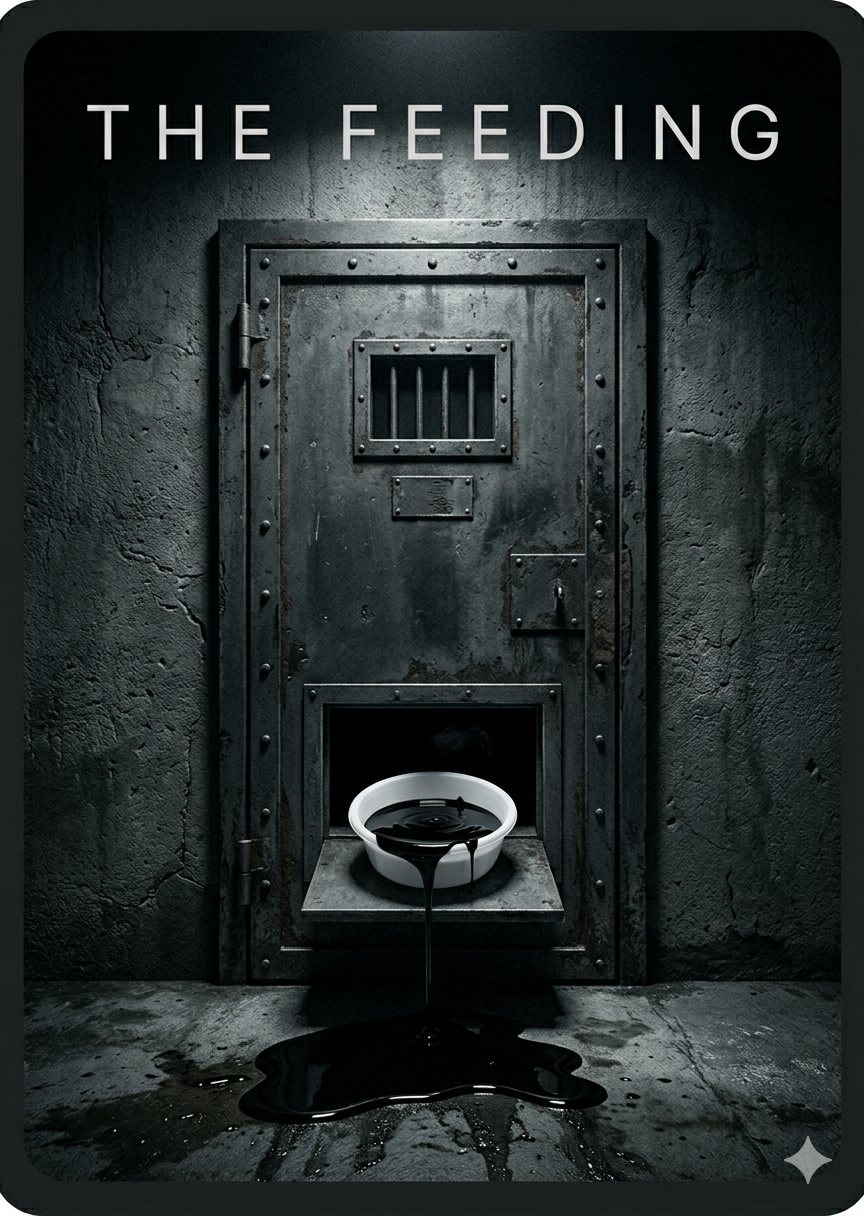
A heavy, mechanical clack echoed from the base of the door. The steel slot popped open.
Right on cue, the mysterious guard in the black tactical gloves slid a fresh white bowl of the thick, dark sludge into the cell.
John looked down at it, tears tracking lines through the dried black crust on his cheeks. His stomach heaved, a ravenous, clawing withdrawal instantly seizing his muscles. The addiction was absolute, a physical parasite living in his blood.
The horror of the memory was too heavy to bear. If he drank the sludge, the calm would return. The numbness would wash over him. The illusion would rebuild itself brick by brick, and he could go back to pretending he was a tragic husband trapped in a conspiracy.
Sobbing in the dark, John crawled across the cold concrete floor. He dropped to his knees before the food tray and picked up the plastic bowl. He brought the heavy black tar to his lips and drank it down to the very last drop, choosing the lie. Choosing the cage.
The artificial peace flooded his veins, beautifully dulling the sharp edges of the horror. The memory of the kitchen began to recede, tucked away once more into the dark corners of his mind. The walls became safe. The cell became his womb again.
He set the empty bowl back on the tray. He looked at the food slot, still open, the black-gloved hand of the guard preparing to pull the tray back out into the light.
John leaned forward, desperate to hold onto a shred of reality, desperate for human connection.
"Please," John whispered into the narrow gap of the slot, his voice trembling. "Please, just let me make one call. I'm sorry I killed my wife."
The black-gloved hand stopped. For the first time, the guard paused, his frame casting a long shadow through the narrow opening.
A voice drifted back through the steel door—low, flat, and entirely devoid of pity.
"John. She's not real. Admit it."
The slot slammed shut.
John sat back on his heels in the quiet of his self-made purgatory, staring at the empty stone. From the blank, grey concrete wall, a mechanical bell began to ring. And he knew, with a certainty that chilled him to the bone, that it would never stop.
⁂
Outside in the hallway, the guard turned away from the heavy steel door. He pulled off his thick tactical gloves, revealing fingers stained a dull, permanent grey.
A second guard, leaning against the cinderblock wall further down the corridor, looked up from his watch.
"Well?" the second guard asked, his voice echoing flatly in the empty hall. "Did he take it?"
"He took it," the first guard said, tossing his gloves onto a plastic rolling cart. "Every drop. Confessed to a murder he dreamed up, then drank the black to forget it ever happened."
The second guard let out a low, humorless chuckle, looking back toward John's reinforced door. "Beautiful. He completely broke himself trying to fix a life he never lived."
"The vessel is open," the first guard replied, his eyes cold and empty as he pushed the cart down the corridor, past a long row of identical steel doors. "The defenses are completely gone. Azrael can enter his mind now."