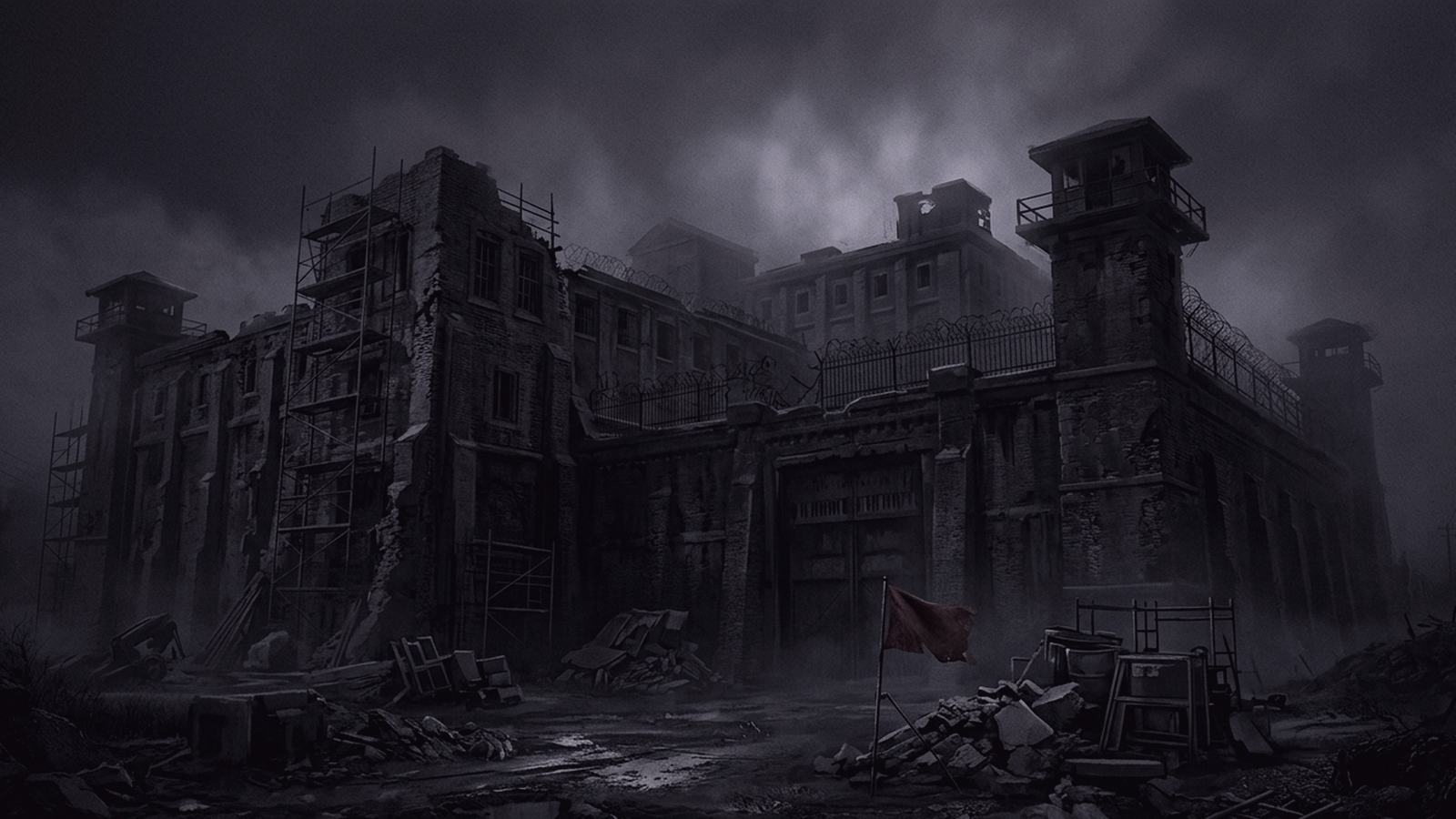
The catwalk was four inches of galvanized steel grating suspended thirty feet above the tier floor. Every time Cyrus Ferreira shifted his weight to feed another yard of coaxial cable into the conduit, the frame groaned through its expansion bolts. The smell never cleared out of the upper galleries: lime wash, dry pigeon dung, and the sour tallow grease they used on the sliding hatch gates sixty years ago.
He carried a twelve-pound steel Kennedy box in his left hand. The knuckles of that hand were scabbed at the middle joints, the skin red and dry from three days of scouring floor drains with caustic soda. His job for the week was simple enough on the work order: survey the vertical utility chases before the wrecking balls arrived on Monday. The State of California paid sixty-two dollars an hour for non-destructive pipe inspection in decommissioned facilities, and Cyrus took whatever the union board posted.
Beneath the catwalk, the tier of Cellblock 2 lay in flat, grey shadow. Forty-eight iron doors, twenty-four to a side, each with an observation slit five inches wide by two inches high. The mattresses had been burned in the yard in November, but the steel strap bunks remained, bolted to the poured concrete walls like butcher shelves.
"Ferreira," a voice called up from the floor.
Hernandez stood on the concrete runner between the cell fronts. He wore an orange safety vest over his denim jacket and held a clip-board with seven yellow carbon sheets clipped to the aluminum.
"Wrapping the second run," Cyrus shouted down. The sound hit the iron roof beams and broke into three distinct slaps. "I need forty minutes on the lateral."
"Take thirty," Hernandez said. He didn't look up from the yellow carbons. His ballpoint pen made a steady scratching sound that carried all the way up to the crane track. "Radio time is three-fourteen. The gate crew locks the outer perimeter at four. If you're still on the high iron when the main breaker drops, you'll crawl down in the dark."
"I've got the Maglite," Cyrus said.
Hernandez did not answer. He turned on his heel, his Vibram soles dragging against the grit of the concrete runner, and walked out through the sally port into the central rotunda. The heavy iron door didn't slam; it caught on its hydraulic cylinder with a dull, pneumatic gasp, then latched.
Cyrus knelt on the zinc grating. The braided lead gave an inch, then held.
He fed three more feet of the inspection head into the six-inch vent pipe. On the four-inch monitor strapped to his chest rig, the lens showed only the interior of a black iron sleeve: white scaling along the weld seam, flakes of rust like burnt oatmeal, and the dried husk of a silverfish pinned to an elbow joint. There was no water standing in the stack.
He pulled the line, coiled the black rubber snake around his elbow, and climbed down the vertical ship's ladder to the mezzanine level. His work boots were double-soled Thorogoods with steel toes. They were dark brown, scuffed at the caps, and fit his feet with the easy give of gear worn every day for three years.
He checked his wrist. He was not wearing his watch. The band had snapped two mornings ago, or so he remembered, though when he touched his left wrist his thumb found only bare, smooth skin without the pale white band of an unburned tan.
On the mezzanine wall, twenty feet from the stair head, an electric Seth Thomas clock hung from a three-eighths masonry anchor. Its glass face had a diagonal crack across the seven, and the black hour hand was frozen midway between three and four. The minute hand trembled against the dial at eighteen minutes past the hour. Cyrus watched it for ten seconds. The hand did not sweep; it twitched in place against the enameled tin, vibrating four minutes fast of the radio time Hernandez had called out from the floor.
He turned left into the service passage behind the control booth. The air was five degrees colder here, trapped between ten-inch structural slabs that had not seen daylight since the Eisenhower administration.
The door to the security substation stood open two inches. The brass cylinder had been drilled out with a half-inch bit, leaving a neat ring of bright yellow shavings across the threshold. Cyrus pushed the flat of his palm against the door. It moved without a sound.
The room smelled of stale toner and the vinegar tang of leaking alkaline batteries. A green metal desk occupied the middle of the floor, its kneehole packed with water-damaged logbooks whose covers had swollen into grey pulp. On the desk sat an old square-cased terminal, an IBM with an amber-phosphor screen. It was plugged into an orange extension cord that snaked through a drilled hole in the back wall.
The amber screen was awake.
In the center of the phosphor raster, five lines of text glowed with steady, yellow intensity:
DAILY BRIEFING - 03/14 UNIT: SPECIAL MANAGEMENT BLOCK D TRANSIT LOG: 02 RECORDING ATTACHED: INTERVIEW 314 STATUS: ACTIVE EVALUATION
Beneath the last line, a small rectangular prompt blinked at fifty cycles a minute.
Cyrus touched the spacebar with the tip of his thumb. The key was greasy, coated with that fine, gray kitchen grease that settles in institutions where lard is heated in five-gallon drums.
The monitor clicked. An internal relay engaged behind the plastic casing, and an audio waveform expanded across the bottom third of the screen.
A speaker behind the monitor's vent slats hissed. The static sounded like dry beans shaken in a cardboard box. Then a woman's voice came through, level and dry:
"Subject shows standard orientation. Gait is ninety percent symmetric. Right lateral reflex delayed by fourteen milliseconds."
A second voice spoke. It was lower, muffled by the microphone baffle, but the rhythm was unmistakable. It paused twice between four-word phrases, the way Cyrus Ferreira paused when he had to read a blueprint while holding a tape measure between his teeth.
"The work order says four hundred feet of six-inch ductile," the second voice said from the speaker. "I brought the half-inch snakes."
"Acknowledge," the woman said.
"Good timing," a voice said behind him.
Cyrus pulled his hand back from the spacebar. The metal edge of the desk caught his hip as he spun.
Rachel stood in the open doorway. She wore the slate-grey field jacket the contractor had issued them on Tuesday, the one with the blue embroidered oval over the left breast that read PACIFIC REMEDIATION. Her hair was pulled back with a black rubber band, so tight the skin at her temples looked stretched. Her safety glasses hung from a yellow cord around her neck, resting flat against her collarbone.
"You're behind," she said.
"Hernandez gave me thirty minutes," Cyrus said. He looked down at the screen. The amber waveform had flattened into a single, thin line across the phosphor. "Who left the power on in here? The substation's supposed to be cold since seventy-nine."
Rachel walked past him. She didn't look at the screen; she looked at the shelf above it, where three empty cardboard rolls sat in a row. "The site engineer ran temporary lines from the guard shack. They need the cameras on four and seven to certify the abatement."
"There's an audio file on this box," he said. He tapped the plastic bezel with his knuckle. "It's got my name on the shift ticket. It's got today's date."
Rachel didn't blink. Her eyes were very pale, the color of pond ice with dirt frozen into it. "That's thirty-four, Cyrus. Look at the raster. It's an old intake file from the county sheriff. They used this wing for weekend drunk holds before the state bought the parcel."
"It says 314."
"It's a three," she said. She reached out with one finger and pressed the red rocker switch on the side of the terminal. The amber line collapsed into a single bright star in the center of the glass, lingered for three seconds, and died. "Pick up your box. We've got eighteen minutes before the yard gates go on air."
She turned and walked into the corridor without checking to see if he followed.
Her footsteps made no sound on the floor. Cyrus took three paces after her and looked down at her boots. She was wearing standard-issue eight-inch Dunlops with green rubber soles, but the grey dust on the corridor floor remained smooth behind her heels. There were no tread marks. There was only the faint, dark trace of moisture, five small oval spots that faded as the concrete drank them.
She isn't leaving prints because the soles are brand new, he thought. They haven't broken the surface glaze.
The thought was smooth. It went down into his chest like cold water, flat and reasonable.
He followed her through the double fire doors into Cellblock 3.
The tier was shorter than the last one: twelve cells on the ground level, twelve above. The air here was thicker, tasting of damp limestone and iron rust. A six-inch cast-iron drain pipe had burst behind cell 308, and three inches of black, stagnant water sat across the central gutter, scummed over with a white skin of calcium.
"This is the run," Rachel said from twenty feet ahead. She stopped outside cell 312. "Check the secondary drop."
Cyrus set his toolbox down on the sill of cell 310. The latch of the box snapped against the steel with a bright, metallic clink.
Opposite cell 312, bolted to the wall between two electrical panels, was a sheet of quarter-inch plate glass in a stainless-steel frame. It had been installed for the guards to see around the blind corner near the shower entrance. The silvering along the top edge had peeled, leaving dark brown clouds where the zinc backing had oxidized against the concrete.
Cyrus looked at his reflection.
He was thirty-eight years old. He had a scar three-eighths of an inch long through his left eyebrow from an alternator belt that snapped in his father's garage in Fresno. His denim shirt was grease-stained at the pocket where he carried his paint markers.
He raised his right hand to touch his eyebrow.
In the mirror, Cyrus Ferreira did not raise his hand.
The man in the glass stood thirty inches away, his arms hanging straight at his sides, his shoulders slightly rounded under the denim shirt. His chest did not move with Cyrus's breath. He simply stood there, staring out through the clouded silvering with eyes that were black in the low light, his jaw set in a hard, square line.
Cyrus took a half-step backward.
A full second later, the reflection took its half-step backward. The heel of the boot in the glass hit the floor with a hollow thump that did not come from Cyrus's boots.
"Rachel," he said. His tongue felt large and dry, like an old sponge.
She was standing three feet to his left, looking into the dark interior of cell 312. She did not turn her head. "It's the optical distortion," she said. "The glass is laminated. Two layers of four-mil acrylic over five-eighths plate. When the moisture gets between the sheets, you get a double image on the focal plane."
"That wasn't a double image," Cyrus said.
"We have fourteen minutes," she said. Her voice was flat, level, totally devoid of the rise and fall of someone speaking in an empty hall. "Check the drop."
Cyrus looked down at his feet.
Beside the threshold of cell 312, sitting on a dry patch of concrete between two puddle rims, was a pair of Thorogoods. They were size 10-D. The leather was dark brown, scuffed at the toe caps, the outer rubber of the left heel worn down by a quarter of an inch where his ankle turned out.
They were his boots.
He looked down at his feet again. The boots he was wearing were identical. The scuff on the left toe was the same three-cornered tear he'd gotten on a rebar peg in Modesto six weeks ago. The laces were yellow nylon with the plastic aglets chewed off the right side.
They buy them by the crate, he told himself. State surplus. Everybody wears the eight-inch plain toe. It's the only boot the contract allows.
The explanation was there before he even finished the question. It arrived whole, like a pre-punched card sliding into an open slot.
"I'm calling the truck," Cyrus said.
He reached into his back pocket and pulled out his phone. The screen was black. He hit the power key; the backlight flared with a pale, cold blue that lit the grease on his fingers.
The display read 3:18 AM.
He dialed Rachel's extension on the site net: 404. He held the plastic to his ear. There was no dial tone, no electronic click of an exchange switching channels. There was only a dry, continuous hiss, like steam venting through a pinhole in a radiator pipe three floors below.
"Hey Rach," he said, his voice dropping into the small space between them. "I'm not getting the telemetry on the monitor. Hernandez must have cut the lateral."
Rachel did not look up from the lock cylinder of 312. Her hands were folded behind her back.
He hung up. He dialed the shop number in Bakersfield, the eight-digit line for Mark's dispatch desk. He pressed the phone hard against his cheekbone until the plastic casing creaked.
The phone rang once. It was a short, sharp electronic chime that sounded inside the ear-piece, followed by an immediate click.
"Mark," Cyrus said. "We're in three. The line's dead."
"The time is two fifty-six," a recorded voice said. It wasn't Mark. It was the woman from the terminal screen, her voice dry, rhythmic, and clear. "Please remain at the station until the technician arrives with the log."
The line went dead.
Cyrus looked at the screen of his phone. The digital clock in the status bar did not say 3:18 anymore. It was 2:56. As he watched, the six disappeared and was replaced by a five.
2:55.
A relay clicked above him.
With a sound like thirty dry sticks snapping at once, every fluorescent tube along the ceiling of Cellblock 3 went dark.
The darkness was not black; it was the color of wet slate. The high, barred clerestory windows along the roofline let in a dull, grey luminescence from the sodium vapor lamps three hundred yards away on the perimeter fence. The iron bars cast diagonal shadows four inches wide across the concrete floor, cutting the corridor into twenty-four grey ribs.
Cyrus turned on his Maglite.
The three-D-cell aluminum tube felt cold in his bare hand. The yellow beam cut through the dust, hitting the mirror opposite cell 312.
The reflection was still there.
It was not holding a flashlight. It stood five feet from the glass, its hands at its sides, its head tilted five degrees to the left. As the yellow beam of Cyrus's Maglite struck the glass, the man in the mirror opened his mouth.
He did not scream. He did not speak. His jaw simply dropped three inches, further than a man's jaw should drop, the skin of his chin tightening until the bone showed white through the stubble. His mouth was an empty black square.
Cyrus did not look at Rachel. He did not speak.
He took three steps backward, turned, and ran toward the double fire doors that led back to the central corridor.
The braided lead gave an inch, then held.
The phrase hit his head with the heavy, rhythmic beat of an engine idling. He didn't know where it came from; he hadn't used the cable puller since nine o'clock.
His boots pounded the concrete. The sound was too loud in the narrow gallery, twenty-four paces of heavy leather slapping against grit. He reached the double doors and threw his shoulder against the panic bar.
The steel bar did not move. It was welded to the chassis. Two three-eighths-inch beads of cold steel, fresh and grey, joined the moving latch to the housing.
The brass doorknob below it was slick with heavy grease. Cyrus grabbed it with his bare hand; his fingers slipped over the cold metal, leaving a greasy smear that smelled of lard and diesel. He pulled with both hands, his heels skidding across the grey paint of the floor. The door didn't rattle. It sat in its steel frame like a slab of tomb granite.
He turned his back to the door and raised the Maglite.
The beam swept the gallery floor.
Twenty feet out, near the threshold of cell 306, a trail of wet footprints came out of the darkness. They were six inches apart, small, narrow prints made by someone walking slowly, their toes pointing straight ahead. They came from the dark interior of the cell, crossed the threshold, took four paces toward the double doors, and stopped.
There were no returning prints. The concrete beyond the fourth step was bone-dry, coated in fifty years of undisturbed lime dust.
Cyrus held his breath.
The silence in the block was not quiet; it was the sound of air being pulled through an intake louver three floors up, a flat, sixty-cycle thrum that vibrated in the soles of his Thorogoods.
"Rachel?" he called out.
The sound of his voice died within four feet of his face. The air had become dense, heavy with the smell of wet clay, river mud, and something else—something scorched, like greasy wool dropped onto an electric stove coil.
He walked toward cell 306. His feet felt heavy, as if the steel caps in his boots had doubled in weight.
The door to 306 was not an iron bar gate. It was a solid steel plate, six feet high by thirty inches wide, painted with thick grey lead paint that had bubbled into blisters along the bottom edge.
The old mechanical tumblers had been removed. In their place, a four-inch square of cold-rolled steel had been welded over the lock pocket, held by four grade-8 hex bolts that had been tightened until the washers bit into the plate.
In the center of the plate, stamped into the metal with a three-eighths-inch steel punch, were five characters:
3-14-A
Below them, etched with an electric pencil into the raw iron:
AUTHORIZED LOG ONLY. DO NOT CYCLE BEFORE 04:00.
Cyrus touched the cold-rolled steel with his middle finger. The metal was thirty degrees colder than the air in the corridor. It smelled of sulfur and machine oil.
The memory arrived before he could pull his finger away.
It was not a memory of a demolition permit. It was a memory of an office in Sacramento with cream-colored acoustic tile and three plastic ficus plants in the corner. Rachel was sitting behind a laminate desk. She wore a beige linen blouse with pearl buttons. She had pushed a blue ballpoint pen toward him across a grey desk blotter, her thumbnail tapping the paper once, twice, three times.
"Sign the second line, Cyrus," she had said. Her voice was not his coworker's voice; it was his wife's voice, the voice that had told him to pick up milk on Tuesday, the voice that had told him his father's bypass had failed in the recovery room. "It's just the intake clearance. The state needs thirty days of cognitive logging before they certify the settlement."
He had signed it.
He remembered the date he had written in the small square beside his name: March 14.
He remembered the number printed in red ink at the upper right corner of the yellow carbon: 314.
He had never lived in Fresno. His father had never owned a garage with an alternator belt. He had never owned a pair of Thorogoods until he woke up on the second-tier bunk in Cellblock 3 four hours ago with the laces already tied in a double knot.
Cyrus looked down at his left hand.
The scab on the middle knuckles was not from caustic soda. It was a line of five neat, circular needle marks where the subcutaneous leads had been inserted into the dorsal vein, their edges blue and swollen under the skin like small lead shot.
He touched his neck, just below the angle of the jaw.
There was no pulse.
There was only a rhythmic, hydraulic flutter, fifty cycles a second, vibrating against his thumb with the steady, quiet hum of a camera line running through forty feet of black iron pipe.
The lock on cell 306 clicked.
The hex bolts did not turn. The door simply drifted open three inches on its heavy, cold-greased hinges, the black interior of the cell yawning behind it like an open mouth.
Inside, on the steel strap bunk, a pair of Thorogoods sat waiting, their toes pointed toward the threshold, the yellow laces tied in an identical double knot.
The braided lead gave an inch, then held.
Cyrus Ferreira stood in the grey light of the gallery, his Maglite beam pointed at the floor, and waited for the breaker to drop.
***
At 6:15 AM, the fog off the bay had cleared as far as the second security fence, leaving the razor wire wet and glistening in the yellow sodium wash.
In the administrative office of the gatehouse, Maria Rodriguez poured two fingers of black coffee from a green Stanley thermos into a paper cup. She took a sip, set the cup on the blotter, and used an orange highlighter to draw a line through the fifth row of the morning transport sheet.
The radio on the shelf above the key box gave two short bursts of static.
"Station One," Rachel's voice said from the small square speaker. The transmission was flat, clear of flutter or line drop. "The lateral survey in Block D is complete. The casing has been seated."
Maria picked up the mic. "Acknowledged, Rachel. Is the unit secured for the shift?"
"Unit 314 is cycled," Rachel said. "Log the intake as routine. We'll need a fresh battery lead for the vertical stack in Block C before the day crew arrives."
"I've got three on the bench," Maria said.
She hung up the microphone on its chrome hook.
She took her red ballpoint pen and opened the black three-ring binder labeled MAINTENANCE CONTRACTS: TEMPORARY DETENTION. On page eighty-four, in the column marked DISPOSITION, she wrote the current time: 06:18.
Beside the entry for Cyrus Ferreira, she stamped the small blue box that read REPLACED, blew once across the wet ink so it would not smudge against the plastic divider, and closed the book.