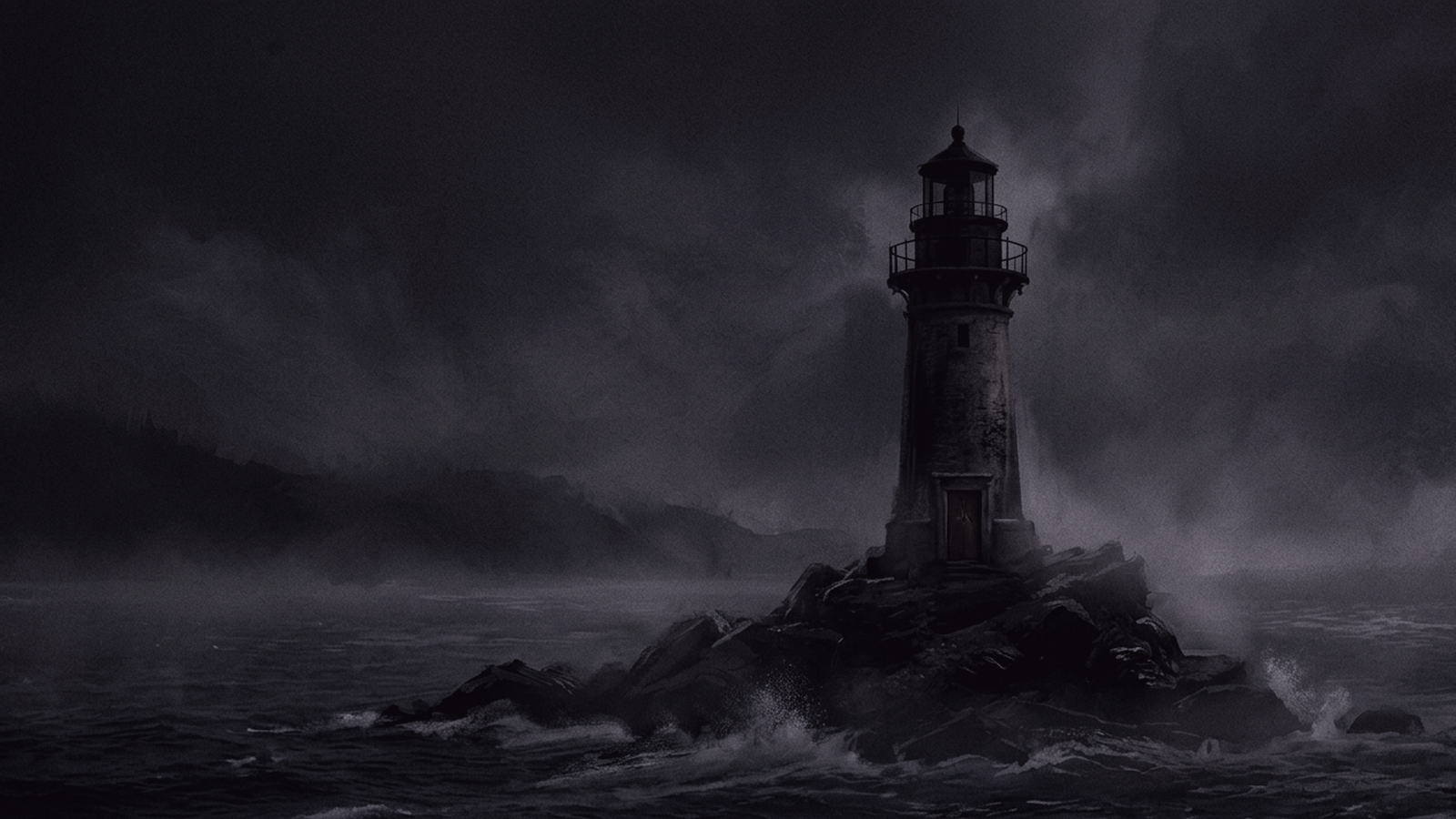
The lantern room smelled of hot tallow, zinc, and battery acid. Outside the circular glass, four miles of grey water heaved against the base of the reef, but Amos Hollowell kept his back to the horizon and his fingers flat against the pine crate. The wood was damp with salt that had dried and crusted into the grain like white rime.
On top of the crate, Mr. Whiskers lay on his left side. The cat was an eleven-pound ginger tom with a notched right ear and dried mucus caked in the corner of his nose. When Amos touched the swelling above the hock, the joint yielded with a small, wet pop that vibrated straight through the latex of his glove into the bone of his thumb.
"Just fluid in the sheath," Amos said. He did not look up. "He took a bad drop off the ladder."
Jenkins stood three feet away, his back braced against the cast-iron column of the central shaft. He held a two-quart thermos wrapped in peeling green electrical tape, the steam from the mouth smelling faintly of chicory and stale condensed milk. Jenkins was fifty or fifty-one, with the thick, yellowed thumbnails of a man who worked wire rope and a permanent grey stubble that stopped an inch below his jawline.
"He don't jump like he used to," Jenkins said. His voice was flat, dried out by eighty-foot winds and kerosene fumes. "He missed the bottom rung coming off the service deck. Landed on the grating."
Amos uncapped the disposable plastic syringe. The needle was twenty-two gauge, an inch long, cold enough to draw condensation from the air as he drew two cubic centimeters of penicillin from the rubber-stoppered vial. He swabbed the skin above the cat’s flank with rubbing alcohol. The smell of isopropyl cut through the salt. When the steel went in, the tom did not claw; he only pressed his chin harder into the crate, his yellow eyes wide and dull, reflecting the red flash of the optic as it revolved overhead.
The optic turned in its mercury bath, a wet scrape every four seconds.
Amos pressed the plunger home with his palm, smoothed the coarse orange hair over the puncture, and dropped the spent plastic barrel into his canvas bag. He pulled his pencil from behind his ear and signed the bottom of the triplicate voucher from the Third District tender: Hollowell, A., DVM. Special service call, Shoal Light No. 4.
"Give him forty-eight hours off the ladder," Amos said, handing the carbon slip across the gap. "Keep the water pan full."
Jenkins took the paper between two grease-blackened fingers. He folded it once, sharply, and shoved it into the breast pocket of his wool chore coat without reading the line items. "Tender’s running five days behind on the relief," Jenkins said. He looked out through the salt-crusted glass toward the south shoal, where the swell broke over the submerged ledge in three dirty grey ribs. "Captain said they had a fouled injector off Monhegan. I’m going down to secure the winch before the tide floods the slip."
"I’ll pack the kit," Amos said.
Jenkins did not answer. His heavy rubber boots scraped down the open spiral of the iron stairs, sixty-eight risers to the landing, the rhythmic ring of his descent growing duller until the heavy oak door to the lower deck slammed shut.
Amos waited for the latch to click. The cat remained on the crate, tail twitching once, a dry flick against the wood, before pulling its paws underneath its breastbone to sleep. Amos buckled the leather straps of his kit, checked his watch—4:40 p.m.—and took the stairs down to the third-floor quarters.
The living quarters were twelve feet across, bounded by curved, whitewashed granite blocks three feet thick. The air here was colder than the lantern deck, stagnant and smelling of wet wool and lye soap. A narrow iron bunk sat against the curved wall, its mattress covered in blue-and-white ticking that had gone grey around the edges where shoulders rested.
Amos set his bag on the linoleum floor and opened the single cedar wardrobe beside the stove. He needed his heavy wool coat; the fog was coming off the water now, thick as mutton fat, and the draft through the granite joints had an edge like wet iron.
In the wardrobe hung three wire hangers. On the first two were a pair of stiff denim dungarees and a faded work shirt. On the third was an olive-drab storm parka with a sheepskin collar. Above the left pocket, sewn in faded yellow cotton tape, were block letters: A. HOLLOWELL.
Amos stood with his hand on the hanger. The wire was cold.
He ran his thumb across the stitching. The *H* was slightly crooked, the second leg pulled tight by a knot on the reverse side—the exact repair his sister had made four winters ago when the seam pulled out on the ferry slip at Rockland.
Jenkins salvaged it, Amos thought. They buy surplus out of the warehouse in Portland. They buy lots by the hundredweight.
The explanation sat thin and dry in his mouth, like chewing cardboard. A lighthouse keeper did not wear a thirty-eight regular; Jenkins was broad-chested, forty-four inches around the ribs at least, with arms three inches longer than Amos’s. Yet the parka hung here, smelling of the cedar lining and the sweet, medicinal grease he used for cleaning his calf-pullers.
He took the coat off the wire. He slipped his arms into the quilted sleeves. The cuffs fell precisely to the base of his palms. The wool collar smelled of his own hair oil and stale tobacco, though he had not smoked a pipe since November.
He took it off, hung it back on the wire, and pulled the wardrobe door shut until the latch engaged.
Amos walked to the cast-iron sink in the corner. The brass spigot groaned when he turned it, spitting two ounces of rust-red slurry before the stream ran clear and thin. He filled an aluminum cup and drank. The water tasted of lime and dead pond grass, the cistern supply from the roof gutters. It left a film on his teeth like river silt.
He sat on the bunk, lit the reading lamp on the small side table—a forty-watt incandescent bulb inside an unshaded zinc reflector—and opened his ledger to check the invoice numbers. The light was pale yellow, weak enough that the corners of the curved room remained in deep brown shadow. Outside, the foghorn let out its two-second blast from the gallery below: a heavy, intestinal shudder that rattled the tin spoons in the drawer beneath the counter.
Amos read through five pages of farm visits—two heifers with mastitis in Hope, a gelding with a gravel pocket in Union—until his eyes burned from the glare. At 9:15 p.m., he reached up and turned the brass key on the lamp socket. The click was sharp. The room went black.
He lay back on the mattress with his boots on, his head on the horsehair bolster, waiting for sleep.
When he opened his eyes, the room had not changed, but the skin of his forehead felt hot, like he had fallen asleep too close to an open hearth. He looked up.
The bulb was off. The brass key was turned vertical, exactly where he had left it. But the glass envelope was throwing a dull, baked-orange radiance into the room—not light, but a dry, searing heat that radiated downward in a circle three feet wide. The air directly below the fixture shimmered like the road in July. When he held his palm four inches beneath the glass, the heat prickled his skin until he smelled scorched hair from the back of his hand.
The optic turned in its mercury bath, a wet scrape every four seconds.
Amos pulled his hand back. He did not touch the switch again. He rolled toward the whitewashed granite, pulled the wool blanket over his ears, and watched the grey mortar lines between the stones until the cold seeped through the wool and settled into his hip.
At dawn, the automatic timer on the supply shelf clicked like a dry knuckle.
Amos stood over the two-burner kerosene stove in the kitchen alcove, waiting for the water in the tin pot to boil. The room was six degrees above freezing. Through the small south-facing port, the sea was invisible, lost in a wall of flat white mist that pressed against the thick glass like lard.
He poured three spoons of rolled oats into the water, stirred them with a wooden paddle, and sat at the square deal table by the window. The wall clock—an eight-day Seth Thomas in an octagonal oak case—ticked with a slow, heavy drop of the escapement.
The hands stood at 6:04 a.m.
He ate the porridge without sugar. The grease from the kerosene burner coated his tongue, flat and chemical. When he set the spoon down, his gaze drifted to the three painted pine shelves above the dry sink where the medical supplies were stored.
On the middle shelf sat a cardboard carton of veterinary sulfa tablets and four rolls of three-inch cotton gauze. Beside them, penciled directly onto the white beadboard three days ago, was a vertical line he had drawn to mark the edge of the dressing stock.
The top edge of the sulfa carton was now sitting precisely six inches lower than the pencil mark.
Amos did not move for nearly a minute. He chewed the lukewarm oats, his jaw working slowly. The shelf was one-inch white pine, nailed into the studs with cut iron spikes. It had not sagged; the wood was level. The box had not moved sideways. The pencil mark remained where he had made it, sharp and dark against the white paint, but the space between the top of the cardboard and the mark was empty air.
The timber settled, he thought. The floor joists took the weight of the coal.
He stood up, took his empty bowl to the sink, and ran a finger over the doorframe between the kitchen and the stairwell. At waist height, the pine had been rubbed concave, the grey paint worn down through two coats of lead primer to the bare, yellow heartwood. His hip fit into the groove with the familiarity of a shoe he had worn for five seasons.
He looked at his pocket watch. The silver case was warm from his thigh.
The hands read 6:32 a.m.
He had eaten three spoonfuls of oatmeal. The bowl was still half-full, the grey skin on the surface only beginning to wrinkle, yet twenty-eight minutes had dropped out of the room between the bite and the swallow.
Amos left the bowl in the dry sink. He took the spiral stairs up toward the service deck, his boots ringing flatly against the iron treads. Forty-four steps. At the thirty-second step, on the small landing where the weight-tubes dropped through the floor, the emergency telephone hung from two iron brackets.
The receiver was off the hook.
It did not hang loose on its cloth-wrapped cord; it lay balanced across the top of the magneto box, its black vulcanite mouthpiece pointing toward the wall. The brass bells above the box were silent.
Amos picked up the earpiece and held it to his ear.
There was no battery hum. There was no static from the shore line. Through the small round holes of the receiver came only the sound of breathing—short, shallow, wet rattling breaths, eight inches away, like a sheep dying of fluke in the mud.
The circuit is grounded, he told himself. It picks up the water across the ledge.
He set the receiver back into its iron forks. The landing clock, bolted to the masonry above the oil lockers, showed 6:52 a.m.
He went up the final twelve steps to the lantern deck. The cat had not moved from the pine crate. Its ginger flanks were still, its paws tucked tight, its eyes filmed over with the cloudy blue glaze of an animal that had stopped blinking hours ago. The swelling above the hock was flat now, collapsed into a dry, hollow pocket of loose skin.
On the iron service desk, the station log lay open between two brass paperweights.
Amos picked up the wooden lead pencil beside the binding. As his fingers closed on the cedar, his grip gave way—not a spasm, but a total absence of tension in his forearm, as if the nerves had been snipped with kitchen shears. The pencil dropped, bounced twice on the grating, and fell through the diamond mesh toward the floor below.
He stooped to follow its fall. Through the iron grid, eighty feet down into the dark well of the tower, he saw nothing but the grey circle of the concrete basement floor.
He stood up, his spine creaking like cold spruce. Beside the desk, tacked to the bulkhead with brass brads, was the storm chart for the middle coast.
The blue ink lines showing the low-pressure track were dated March 14th. They were drawn in his own small, cramped handwriting—the back-slanting letters he had used since grammar school, the specific way he crossed his capital *T* with a hook to the left. The pencil notation below the isobar read: Tender missed tide. Coal low. No signal from White Head.
He looked at the Seth Thomas clock above the desk.
The minute hand was wedged against the brass pin at 6:58 a.m. The second hand did not sweep; it jumped back and forth across the space of three-sixteenths of an inch, vibrating like a trapped wasp, clicking against the silvered face without advancing.
The optic turned in its mercury bath, a wet scrape every four seconds.
Amos descended the stairs to the radio deck. The transmitter was an old Navy-surplus bench model in an olive-drab steel housing, its dials locked behind heavy glass bezels. He flipped the heavy knife switch for the dynamotor.
There was no whine of the motor generator. No smell of ozone or hot copper.
Instead, from the black perforated grill of the speaker came Jenkins’s voice, small and clear, like someone speaking through a tin funnel from the bottom of an iron pipe:
"—relief boat’s progress. Amos thought he’d settled in for a quiet evening. Amos thought he’d settled in. The darkness outside seemed to seep in. Jenkins had left for the night."
The voice did not pause for breath. The words had no weight behind them; they were flat, rhythmic, delivered with the mechanical regularity of an engine firing on one cylinder.
Amos reached behind the cabinet. His fingers found the primary power lead. The two-wire cable was not plugged into the bulkhead receptacle; the copper ends had been cut clean with wire nippers, the bright metal tarnished green with salt crust.
The speaker continued: "—parka with his name on yellow cotton tape above the left pocket. Amos was just being paranoid. Poured himself a glass of water from the tap, listening as the droplets—"
He turned his back on the radio and walked down to the kitchen.
On the deal table, the toast from yesterday morning lay on the tin plate. It was no longer dry bread. The slices had collapsed into a grey, gelatinous smear that smelled of lard and cold hog fat. In the center of the mess, three white maggots, no longer than a grain of rye, squirmed weakly in the grease.
Beside the plate sat the green Stanley thermos Jenkins had been carrying.
Amos reached out and touched the steel neck. It was boiling hot. Steam hissed from the seam of the cork stopper with a high, thin whistle that cut through the sound of the surf outside. He gripped the stopper and pulled.
The thermos was empty.
Inside the steel vacuum bottle, the walls were bone-dry and coated in a red, powdery rust that smelled of iron filings and vinegar. Yet when he held his palm over the open mouth, the heat blistered the meat of his thumb in two seconds flat.
This is getting worse.
The thought was not his own voice; it was a printed line across the back of his eyes, black ink on yellowed pulp.
The air in the kitchen dropped five degrees in the time it took to draw breath. The light from the south port did not fade—it simply shrank, pulling back from the walls toward the center of the glass until the corners of the room were black as a coal bunker.
Then came the weight.
It was not the wind. The wind struck the tower from the northeast in long, shuddering gusts that made the lantern glass sing. This was a vertical load: a dry, grinding pressure that began at the top of the tower and pressed down through seventy feet of granite ashlar, through the cast-iron core, down into the bedrock below the basement floor. The mortar between the stones began to weep a fine, grey dust that fell like flour across the shoulders of his coat.
Amos tried to step back from the counter, but the soles of his work boots were locked to the linoleum. When he looked down, the rubber had not stuck; his feet simply refused the signal from his hip. His knees were cold, the patellas numb as river stones.
Through the doorway to the sleeping quarters, the brass nameplate on the wardrobe gleamed in the dying grey light.
Above the name JENKINS, stamped into the brass plate with steel punches, was a ten-digit number: 1234567890.
It was his own license number from the Maine Department of Agriculture. The number on his brass tags. The number stamped on the cedar chest where his dead wife’s linen was stored in Belfast.
On the deal table lay the tower logbook. It had not been on the desk above; it was here, open to the page for March 3rd.
The entry was written in his own hand, the ink dry and brown:
3:14 p.m. Keeper Jenkins failed to meet the tender at the slip. Found on lower landing. Remains removed to cistern vault. Relieved post by order of Third District.
Below that line, covering forty pages in the same small, slanted script, were three thousand entries, all identical, each marked four seconds apart:
6:58 a.m. Optic turning. 6:58 a.m. Optic turning. 6:58 a.m. Optic turning.
Amos looked down at his right hand. The skin on the back of his knuckles was yellow, dry as birch bark, the fingernails split down the center and packed with the grey dust of the mortar. When he tried to close his fingers into a fist, the joints did not bend; they clicked once, dry and stiff, like the legs of a dead grasshopper.
The optic turned in its mercury bath, a wet scrape every four seconds.
The vibration in the tower settled into a permanent low hum that vibrated through the marrow of his shins. Above him, on the lantern deck, something heavy shifted its footing on the iron grating—a three-hundred-pound scrape of salt-hardened rubber that moved six inches toward the stair head and stopped.
He did not look up. He could not turn his neck. The Seth Thomas clock on the wall gave one loud, metallic twang as the mainspring sheared its arbor, but the hands remained pinned at two minutes before seven.
***
The Third District maintenance tender Clover made the shoal mooring at 11:20 a.m. on March 21st, eight days behind schedule following engine repairs at Rockland.
The inspection party found the lower entry door bolted from the inside. After forcing the oak jamb with a six-foot pry bar, the third mate logged the interior temperature at thirty-one degrees Fahrenheit. The coal bunker was two-thirds full, though the stove in the living quarters had not been cleared of clinkers in several weeks.
On the service deck, the station inventory was found complete and in order. The supply sheets showed twelve gallons of mineral oil remaining in the service tanks and forty-two cans of condensed milk in the pantry locker, representing a standard thirty-day ration for one man. A stray tomcat, ginger, was found dead of exposure on a packing crate in the lantern gallery; the carcass was dropped over the leeward rail by the deckhand.
The station log contained regular meteorological entries through March 14th, after which the pages were blank. A notation in the margin of the fuel report indicated a 3.2 percent loss of efficiency in the optic rotation gear, attributed to salt accumulation in the lower mercury trough.
The keeper’s personal effects—one wool-lined storm parka, size thirty-eight, and a leather veterinary satchel containing thirty-two empty glass vials—were inventoried, tagged with voucher number 1234567890, and set on the slip for the afternoon boat to the mainland. The third mate wound the Seth Thomas clock, reset the hands to 1:15 p.m., and left two men from the relief crew to scrape the rust from the kitchen counter before the evening tide.