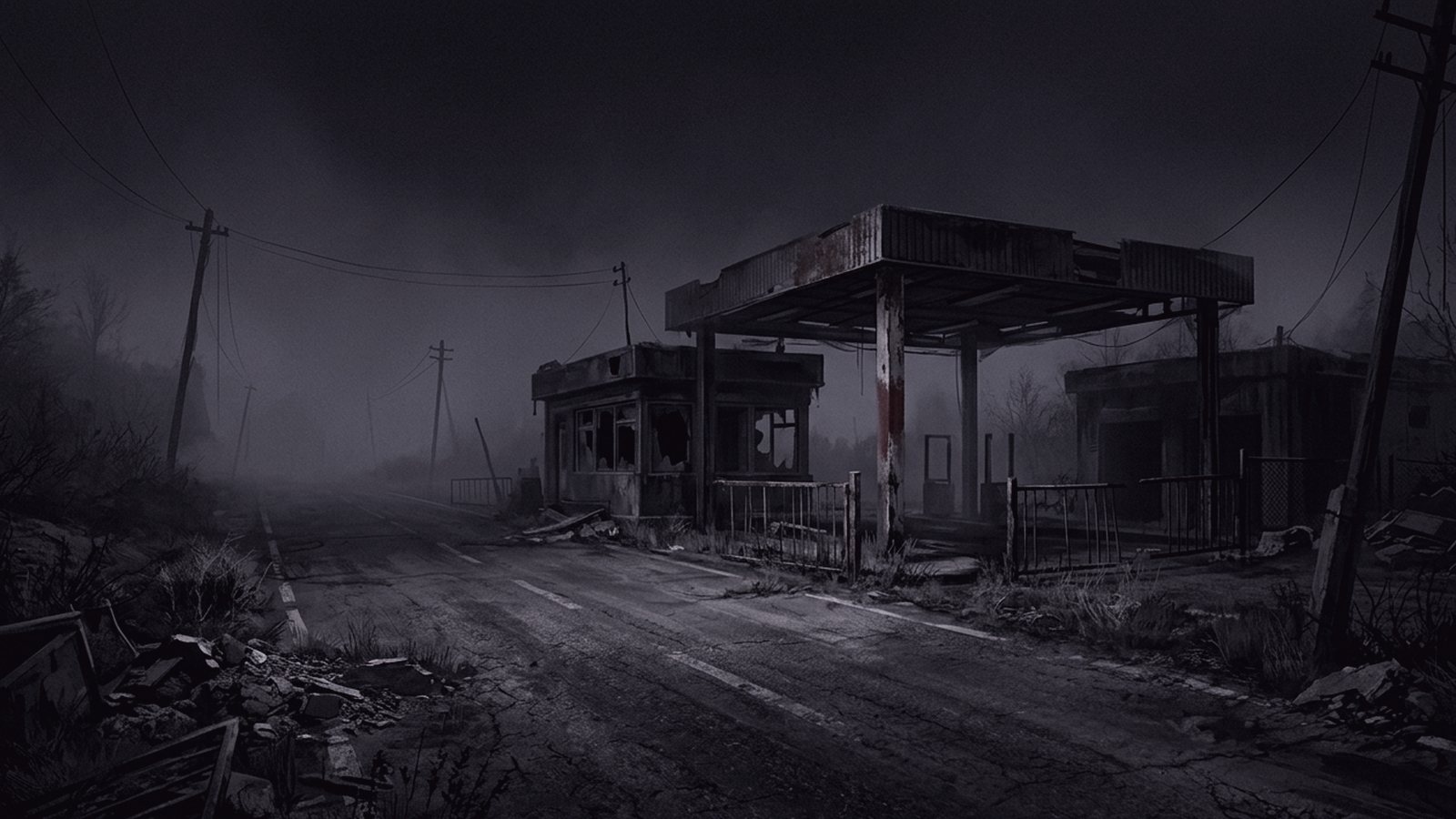
The 1994 Buick LeSabre took the gravel turnout with a dry, iron rattle, its rocker panels already eaten through with road salt. Adele Norrell kept her foot light on the brake. Dust rose behind the rear glass in a pale, boiling wall, settling over the weeds that grew through the seams in the tarmac.
She had left Highway 9 two miles back to skirt the line of cars creeping toward the municipal cemetery. Her mother’s service was set for two in the afternoon, but the funeral home had called twice before dawn about the flowers, and her sister Clara was already at the chapel, arranging prayer cards with the frantic, useless energy of someone who had not touched the old woman while she was sick. Adele had packed the Buick’s trunk at midnight: four heavy cardboard liquor boxes containing wool cardigans, thirty years of cancelled checks, and two copper molds shaped like fish. The secondary crossing at Blackwood Creek was slated for decommissioning on the first of the month. She had wanted thirty minutes of asphalt where nobody knew her maiden name.
The inspection booth sat under a rusted corrugated canopy that cast a blue-grey shadow across both lanes. A single eight-foot fluorescent tube hung from two chains over the barrier gate, its ballast singing a low, wet note that she could hear through the closed windows of the car. The booth’s steel cladding had blistered into flakes the color of dried liver.
Adele rolled her window down four inches. The air coming off the salt flats smelled of stagnant ditch water and burnt engine oil.
The inspector inside the booth had grease under his nails and three days of silver stubble along his jawline. A name tag pinned crookedly to his grey poplin shirt read M. VANCE. He did not look at her face; he looked at the dashboard, then down at the clipboard he rested on the rubber seal of his sliding window.
"State your business," he said. His voice had the flat, spent quality of a man who had worked twelve-hour turnarounds since the interstate opened.
"Passing through to North Creek," Adele said. "Family property. Linens and paper."
He shoved a yellow slip through the gap. The paper was rough, printed on wood pulp that tore slightly under the nib of the tethered ballpoint pen. She wrote her surname, her mother’s maiden name, and the vehicle registration. The pen leaked blue ink onto the side of her thumb.
Vance took the slip back, glanced once at the trunk, and pulled the manual release for the counterweight gate. The cable whistled through its pulley. He did not stamp the slip; he handed it back through the gap.
"Second bay," he said. "Park on the treadles. Turn the lights off."
Off to the left of the lane, behind a plate of wired security glass, a waiting room sat empty under an unshaded fifty-watt bulb. It was four paces wide and six paces deep. The only furniture was a single beige polypropylene stacking chair placed directly against the north wall, facing a window that looked out on thirty miles of dead scrub oak. The linoleum around the chair was grey with four decades of ground-in silt, but the four rubber feet of the chair had left no circles in the dust. The plastic of the seat was bright and clean. Someone had wiped it with a damp rag that morning.
Adele put the Buick in drive. The metal tread gave under the front tires with a dull, hollow slap.
The inspection bay was sixty feet of poured concrete under an arched roof of ribbed zinc. To her right, three bays of heavy industrial shelving reached twelve feet into the gloom, each tier loaded with wire-bound crates and grey cardboard totes with stenciled markings: PUMP CASTINGS (3), FABRIC ROLLS—REJECTED, STRUCTURAL HARDWARE (UNSORTED). A lone tungsten lamp burned above the highest shelf, its filament trembling in the draught from the overhead doors.
She cut the ignition. The engine pinged as it began to cool, three distinct, metallic clicks from the exhaust manifold.
When Adele stepped out onto the slab, the air was six degrees colder than the gravel outside. It had the dry, alkaline reek of lime bags stacked in a cellar. Her heels made a small, distinct clatter against the expansion joints. She took her mother’s leather handbag from the passenger seat and walked down the painted yellow corridor toward the district office door.
A tired clerk with thinning grey hair sat behind a counter of pale green Formica. His sleeves were rolled twice to show forearms pale as lard, hairless and mapped with blue veins. Three other drivers stood ahead of her in the queue, their shoulders stooped, none of them speaking. The only sound was the dry shuffle of paper and the intermittent chitter of a ribbon printer against continuous-feed paper.
Adele took a numbered metal disc from the dispenser by the turnstile. Number 31.
She picked up an issue of an agricultural trade circular from the rack beside the radiator. The pages were swollen from humidity, the staples crusted with white zinc bloom. Between the market reports for feed oats and a two-page spread on grain augers, a snapshot had been tucked into the binding like a bookmark. It was an ordinary color print, four by six inches, printed on matte paper with the rounded corners common in the early nineties.
In the center of the print, three people stood against the timber railing of the North Rim of the Grand Canyon: Adele at nineteen in her faded denim jacket, Clara squinting against the noon glare, and their mother holding a straw hat to her crown with both liver-spotted hands. The sun had burned their foreheads red.
Adele stared at the print until the grain of the paper resolved into tiny yellow and magenta dots.
Behind the timber railing, thirty feet to the left where the red dirt trail sloped down into the scrub juniper, a man was leaning his shoulder against a limestone boulder. He wore a grey poplin work shirt buttoned to the collar and a pair of dark cotton trousers. His face was turned three-quarters away from the lens, looking down into the gorge. His hair was cut short, grey at the temples, parted on the left side with a straight, white line of exposed scalp.
A stranger, she thought. The canyon gets five thousand people an hour in July. Clara must have tucked it into the magazine when she cleaned the hall closet.
The thought was smooth and reasonable, but her throat felt dry. She had not brought the magazine from her mother’s house. The circular was dated October of the current year.
"Number thirty-one," the clerk said.
Adele set the circular back on the shelf, leaving the photograph between the pages. She walked to the counter, her leather purse tucked tight beneath her elbow.
The clerk did not look up from his ledger. He had a glass jar of blue water on his desk with three rubber finger-pads soaking in it. "Vehicle registration. Origin. Two copies of the cargo manifest."
"My mother died on Tuesday," Adele said. Her voice sounded thin in the high-ceilinged room. "The boxes are personal goods. Clothes and old paper. The man at the gate said I only needed the clearance slip."
The clerk reached out a hand. His skin was cold, the nails trimmed straight across into square, chalky edges. He took the yellow gate slip she held out. He held it up to the daylight coming through the wire-mesh glass of the high transom, his thumb covering her signature.
"This is an interim voucher," he said. He did not blink. "Storage room four. You have to sign the release on the manifest before the barrier drops."
He stamped the slip twice with an inked wooden block. The purple ink smelled of methylated spirits.
As she turned toward the double doors that led to the secondary holding area, Adele’s shoulder brushed against a cork bulletin board nailed to the wall between two metal lockers. It was crowded with yellowed notices: a faded diagram on CPR technique, a schedule of district tolls from 1986, and six color photographs pinned with round red tacks.
She stopped.
In the third photograph, four men in heavy canvas coats stood on the concrete apron outside the Blackwood station, holding a fish between them on a length of bailing twine. The image was faded to the color of tea. In the upper right corner, standing by the high chain-link gate that led to the drainage sump, the same man in the grey poplin shirt stood with his arms hanging at his sides. His face was tilted toward the lens, but his features were lost in the grain of the print—only the straight, white part of his hair remained sharp.
A state employee, she told herself. Her tongue felt large and dry against her teeth. He worked the district thirty years ago. He was there when they paved the turnout. It’s an old facility.
The latch of storage room four gave under her hand with a sharp, greasy thud.
The room was nine feet wide and twenty feet long, lined with unpainted pine shelving that had warped under the weight of rusted galvanized fittings and sealed cardboard cartons. The ceiling was low—not more than seven feet—and ribbed with exposed conduit. The only light came from a single bare sixty-watt bulb hanging from an orange cord, swaying slightly in the draft from a ceiling vent.
Adele walked down the narrow central aisle between the stacks. Her mother’s name had been written on the paperwork, but she did not see the boxes from the Buick.
Instead, the air smelled intensely of fresh tobacco smoke—not the dry, stale stink of an old ashcan, but the blue, stinging smoke of a cigarette that had been stubbed out five seconds before she turned the handle. She looked down at the concrete floor. There was no butt. There was no ash.
Someone was here before me, she thought. Vance came through while I was at the desk.
She turned to leave, but her sleeve caught on a protruding splinter of the pine shelving. She jerked her arm back, tearing two threads of her sweater.
On the cinderblock wall beside the inner security door, six inches above the light switch, someone had drawn a series of vertical marks in white tailor’s chalk. They were drawn with mechanical regularity, each line exactly two inches high, spaced a quarter of an inch apart. She counted them with her thumb moving in her coat pocket.
Twenty-seven. Twenty-eight. Twenty-nine.
A horizontal line slashed across the sixth group of four. Thirty.
Then a single fresh stroke, the chalk dust still clinging in white granules to the rough aggregate of the block: thirty-one.
Adele reached out and touched the thirty-first mark. Her fingertip came away white. The chalk was dry and soft, not more than ten minutes old.
The maintenance man, she thought. Her ribs felt tight, like a canvas band cinched around her chest. He’s counting the crates. They’re doing an inventory before the auction on the first.
She turned away from the wall and walked back into the vestibule. The hallway was empty. The clerk was no longer behind the green Formica counter; his swivel chair was tilted back against the grey filing cabinet, the seat empty, the blue water in the rubber-pad jar perfectly still.
Adele took her mobile phone from her bag. There were no bars on the screen—only the small, grey outline of a crossed-out antenna. She walked to the wall-mounted landline beside the staff restroom, picked up the heavy black receiver, and pressed it to her ear.
There was no dial tone. There was only a faint, rhythmic pulsing, like a wet pump working at the bottom of a well: three short strokes, then a pause of four seconds.
She pressed the cradle twice. The pulsing did not change. She dialed Clara’s home number from memory, seven turns of the heavy plastic dial, but the rhythmic click on the line never interrupted itself.
The lines are down along the creek, she told herself. They always drop when the wind comes up from the flats.
She hung the receiver on its hook. The metal bell inside the unit gave a tiny, sour chime.
Adele walked to the heavy exit door that opened onto the concrete apron where the Buick was parked. She pushed the brass panic bar with both hands. It went down two inches and stopped with a hard, dead clink.
She backed up half a pace and hit the bar with her shoulder. The metal frame did not shudder. The lock cylinder was flush with the steel plate, without a keyhole or a thumb-turn on the inside.
They lock the bay while the trucks are on the scales, she thought. Her heart took a slow, heavy stride against her sternum. It’s an automated fire lock. You have to wait for the clearance cycle.
She tried the interior doors. The door to the ladies’ restroom swung open smoothly on oiled hinges, revealing two grey stalls and a mirror spotted with brown age-marks. The door to the supply closet was unlocked; inside, five boxes of paper towels and a yellow mop bucket sat in the dark. Only the heavy exit to the lane was dead.
The temperature in the vestibule dropped five degrees in three minutes. Adele pulled her cardigan tight across her throat. Her breath did not fog, but the skin across her knuckles contracted, turning pale and dry as salt.
Then the fluorescent tubes above the counter went out.
There was no flicker and no click. The humming ballast simply died, and the room was plunged into the grey, watery half-light filtering through the wire-glass clerestory windows twelve feet up. The electric fan behind the Formica desk wound down over seven seconds, its plastic blades ticking against the wire cage until they stopped.
Adele stood with her back against the doorframe of the storage room.
The wood of the casing was bare pine, rounded off by years of contact. Her right shoulder settled into a hollow in the timber, two inches wide and six inches long, where the wood had been worn completely smooth, through three layers of grey enamel down to the pale grain underneath.
Her shoulder fit the hollow with greasy precision. The curve matched the line of her clavicle down to the sixteenth of an inch.
She looked at the battery clock mounted above the clerk’s empty chair. The black minute hand sat directly over the forty-seven.
She watched it for sixty seconds. The thin red second hand did not advance. It twitched once every four seconds, vibrating in place like a trapped hair, but it never moved off the twelve.
The battery is flat, she thought. The battery failed while I was in the back.
Then the hand jumped backward. It fell from twelve to eleven with a dry plastic snap, hung there for a beat, and fell again to ten.
Adele took three paces into the center of the room. The air had a strange, leaden weight to it now; it tasted of copper pennies and dry lime, so thick she had to swallow twice to draw it into her throat. Her ears popped with a sound like wet paper tearing.
The pressure inside her skull increased until the root of her third left molar began to throb in time with the pulsing she had heard on the telephone wire.
This is a panic attack, she thought. Nothing more. A vasovagal episode because I haven't eaten since yesterday noon.
She turned back to the clock. The face was no longer white paper. Behind the glass, a rectangular digital display had appeared through the yellowed plastic, its faint blue liquid-crystal segments burning through the paper face:
11:48.
The numbers were upside down.
Adele took another breath, but her lungs would not expand completely. It was as though a flat stone weighing twenty pounds had been laid across her sternum. The hair along her forearms did not stand up; it lay flat against her skin, glued down by a cold, greasy sweat that smelled of sulfur.
The fluorescent tubes came back on.
The light was not the warm, pinkish glare of commercial lighting. It was a flat, blinding violet, so intense that the corners of the room vanished into grey haze.
The green Formica desk was gone.
In its place stood a continuous wall of poured aggregate concrete that curved away into the dark on both sides, thirty feet high and perfectly smooth, without an expansion joint or a form-tie mark. The surface was wet with a thin film of grease that ran down the face in vertical grey threads.
In the center of the curved wall, twenty paces from where Adele stood, a figure stood facing the barrier.
It was wearing a grey poplin shirt with two breast pockets, the collar buttoned tight against the throat. The cloth was clean, stiff with starch that had never been broken by washing. Its arms hung down along its seams, the fingers curled into loose, identical hooks.
Adele tried to take a step backward toward the pine doorframe, but her left knee gave three inches and locked with a dull, grinding pain behind the patella. Her heel hit the concrete slab.
A drop of moisture fell from the zinc roof sixty feet above. It struck the toe of her left shoe with an audible, heavy plink.
The figure did not turn around, but its neck lengthened by an inch as the chin rose toward the ceiling. The hair was cut short, grey at the temples, parted on the left side with a straight, white line of exposed bone where the scalp had split without bleeding.
Along the curved concrete wall, at intervals of six feet, thirty-one bronze plates had been set into the aggregate with tamper-proof bolts.
Adele did not have to walk closer to read them. The letters were stamped three-eighths of an inch high into the cold metal, filled with black lead paste:
17-4321 — CLARA NORRELL (VOID) 11-2198 — MARGARET NORRELL (VOID) 05-8234 — ADELE NORRELL (PENDING)
Below the third plate, chiseled into the concrete floor in numbers that had been filled with sulfur and smoothed flat with a trowel, a record of entries ran in a single straight line toward her feet:
3:14 a.m. — OCT 12, 1983 3:14 a.m. — OCT 12, 1994 3:14 a.m. — OCT 12, 2005
The intervals were eleven years. Exactly eleven years, to the minute.
She looked at her watch. The hands were gone from the dial. There was only the blank, scratched crystal over a circle of brushed tin.
The figure in the grey poplin shirt took one pace forward. Its joints made no sound, but the grey concrete under its boots groaned with the dry, splitting crack of stone under hydraulic pressure.
Adele felt her chin rise. She did not want to lift it; the muscles in the back of her neck tightened like twisted hemp, knotting against the base of her skull until her teeth clicked together. Her jaw shifted half an inch to the left with a wet, soft tear of the tendon.
She did not scream. Her tongue was pressed flat against the roof of her mouth, dry and hard as wood.
The station was silent for three miles in every direction.
***
At 6:47 a.m., Rodriguez turned the key in the padlock on the external security gate.
The lock had rusted from the salt fog, and he had to strike the brass body twice with the flat of his pliers before the shackle popped. The heavy chain fell into the weeds with an iron clink.
A 1994 Buick LeSabre was parked in the secondary bay, its tires three inches deep in the silt that had blown over the treadles during the night. The engine was off, but the driver’s door stood four inches ajar, the interior dome light having burned down to a dull red filament that died as he watched.
Rodriguez took his clipboard from the hook inside the utility booth. The air in the bay smelled of his own thermos: black tea steeped twice with a pinch of chicory, tasting faintly of the stale tobacco in his jacket pocket.
He walked around the Buick once. The trunk was empty, down to the grey fiberboard over the spare tire well. On the back seat lay a yellow clearance slip from the state board, stamped twice with purple ink that had dried twenty years ago.
The back door to the utility corridor was unlocked. On the concrete sill, a grey smudge two inches wide showed where a rubber heel had slid sideways off the riser into the gravel.
Rodriguez went into the control office, took off his canvas coat, and hung it on the brass peg behind the door. He turned the switch on the electric kettle. The green Formica counter was clean except for three dead houseflies on the windowsill and an agricultural circular from five years back, its cover torn across the corner.
He sat down in the swivel chair, uncapped his thermos, and poured three ounces of tea into the plastic cup.
On the desk, directly beside the jar of blue water, lay an administrative memo from the district supervisor regarding the demolition of the Blackwood Creek crossing. The scrap crew was scheduled for the first Monday of November. They had twenty-eight structures to clear along the old right-of-way, including four concrete culverts and the storage bays behind the scale.
Rodriguez signed his initials on the morning inspection line: J.R. 06:50.
Through the wire-mesh glass of the office window, the single beige chair in the waiting room sat directly against the north wall. A woman’s leather purse lay on the seat, its strap coiled once around the plastic leg.
He looked at it for five seconds while the tea cooled in his hand. Then he reached for the logbook, drew a single line through the license number of the Buick, and turned the page to the manifest for the road salt delivery due at noon.
Above his head, the air conditioning unit clicked once and began to turn over, rattling the loose zinc screws in the ceiling with a dry, continuous purr.